A mother throwing herself over her child as a Russian glide bomb explodes in Sumy is not a movie scene—it is the new face of modern war caught on security camera.
Story Snapshot
- Security cameras recorded civilians diving for cover as Russian glide bombs hit a busy Sumy street.
- At least five people were killed and 17 wounded, including two young children and their mother.
- The strike fits Russia’s wider pattern of using cheap, powerful glide bombs to pound Ukrainian cities.
- Media and officials agree on the core facts, while social media skeptics still question what they see.
Cameras show exactly how fast a normal day can turn into a battlefield
Security cameras around a coffee shop and bus stop in Sumy were rolling like any other day. People walked, waited for transport, checked their phones. Then, in one frame, a bright flash and shockwave tore through the street as a Russian guided aerial bomb hit nearby. Bodies dropped to the ground. One mother pulled her child close and shielded them with her own body, a moment now replayed across news and social media.
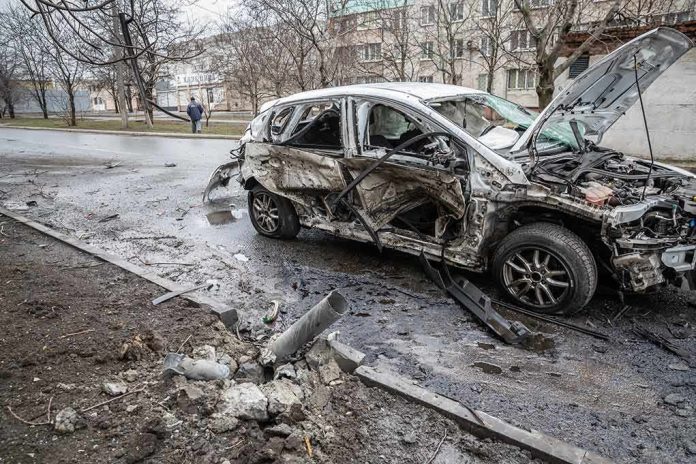
The footage does more than document an explosion. It shows how this strike targeted a clearly civilian area: a public transport stop, a road, nearby homes, and small businesses. Windows shattered. Cars and buses took direct hits. A restaurant and gas station were badly damaged. This was broad damage in a crowded place, not a near miss on some hidden bunker. That matters when people argue over what counts as a legitimate target in war.
Who was killed and how the toll changed as rescue crews worked
Initial reports said four people had been killed, including a 13-year-old girl, with 17 injured. As emergency crews kept pulling victims from wreckage, the death toll rose to at least five. Regional governor Oleh Hryhorov later confirmed that the dead included that 13-year-old girl and a five-year-old child who died with her mother. Those are not abstract numbers; they describe very young lives cut off in seconds because they stood at the wrong bus stop at the wrong time.
Ukraine’s State Emergency Service reported 17 wounded in the Sumy blast, a figure repeated by several major outlets. That level of agreement across official statements and independent media usually signals a settled fact. Casualty numbers often shift in the first hours after any strike, but here they stabilized quickly. From a common sense, conservative view that values clear evidence, this convergence supports the basic claims about how deadly the attack was.
Glide bombs as Russia’s preferred tool for hitting cities from a distance
Ukrainian officials identified the weapons used in Sumy as Russian glide bombs, guided aerial bombs fitted with wings and simple targeting systems. Analysts who track the war say Russia now uses thousands of these every month, often from planes flying high and still inside Russian airspace. That distance protects the crews while letting the bombs fall onto cities like Sumy with little warning. Glide bombs are cheaper than fancy cruise missiles but can still flatten whole apartment blocks.
Security cameras capture the moment civilians in Ukraine's Sumy scramble for cover as a Russian glide bomb explodes nearby, blowing out the windows of a local coffee shop.
Additional video shows people lying on the ground outside, trying to shield themselves as the blasts tear… pic.twitter.com/XuQZOvLsTi
— Fox News (@FoxNews) July 13, 2026
Research groups tracking attacks in Ukraine report that glide bomb strikes rose sharply in late 2024 and early 2025, and that civilian deaths from remote attacks jumped by about 30 percent compared with the year before. Sumy has climbed into the top tier of hardest-hit regions. This attack was not a freak event; it was part of a larger pattern in which Russia uses stand-off weapons to break infrastructure and morale without risking many ground troops.
Information war: strong facts, loud videos, and lingering doubts
On the core facts of this strike, there is little real dispute. Multiple videos show the blast and civilians scrambling for cover. Ukrainian emergency services and major outlets like Reuters and Yahoo News report five killed and 17 wounded, and no named, sourced counter-report challenges that. No Russian forensic evidence has been released to claim the bombs were misfired Ukrainian weapons or that the target was strictly military. For once, the fog of war is thinner than people think.
Yet skepticism pops up in comment sections under the Sumy videos, with users writing lines like “Nobody believes that in this time.” Some of this doubt is healthy mistrust of propaganda on both sides. Some is reflexive denial. From an American conservative perspective that prizes reality over spin, the better path is not blind trust or blind doubt, but asking: what do we actually see, what do named sources say, and who has offered hard evidence to challenge it? On Sumy, the evidence lines up on one side.
Why this one blast matters beyond Sumy
The Sumy footage has struck a nerve because it shows the human cost of a strategy, not just a single horror. Russia’s use of glide bombs makes civilian areas near the front lines feel permanently unsafe, even on days without sirens. People step onto a bus or walk into a coffee shop, knowing that a bomb released dozens of miles away can turn that spot into a crater in seconds. That is a very different way of living than most of us can easily imagine.
For Western readers, the scene of a mother shielding her child at a bus stop is uncomfortably familiar; it could be any town, anywhere. That shared image cuts through dry debates over aid packages, missile defenses, and red lines. Policy choices in Washington, Brussels, and Moscow decide whether Sumy and cities like it keep facing bombs from the sky as part of a normalized tactic. The cameras did not just capture a crime; they captured a warning about where modern war is heading if free societies look away.
Sources:
facebook.com, instagram.com, youtube.com, usnews.com, japcc.org, ukrinform.net, yahoo.com, x.com, rferl.org, kyivindependent.com