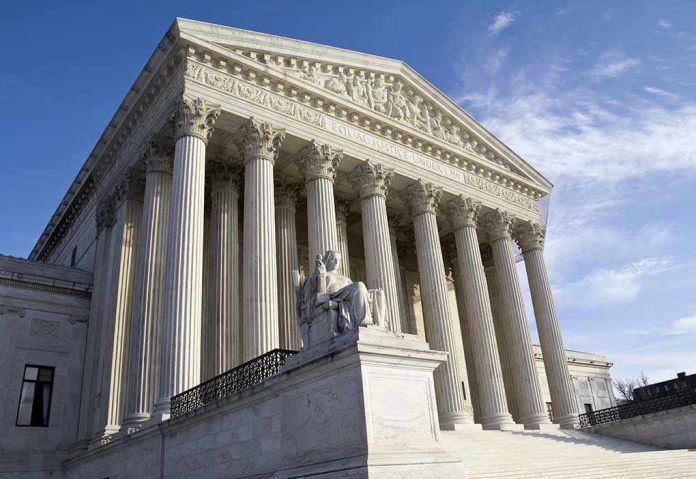
The Supreme Court just handed Texas Republicans a quiet procedural win that could reshape who controls Congress in 2026—and almost nobody outside political insiders is paying attention yet.
Story Snapshot
- The U.S. Supreme Court allowed Texas to use a Trump-backed congressional map for the 2026 midterms.
- The decision strengthens Republicans’ path to keep, or even expand, their edge in the U.S. House.
- The ruling turns obscure redistricting law into a real-world test of election integrity and representation.
- The legal fight is not over, but the political clock now heavily favors the map’s defenders.
How a Quiet Court Order Could Tilt the Next Congress
The Supreme Court did not need a primetime press conference to move the political chessboard; a brief order allowing Texas to use its redrawn congressional districts for 2026 did the work. The map at issue did not appear from nowhere. Texas Republicans, aligned with Donald Trump’s broader strategy to lock in structural advantages, engineered districts that protect incumbents and shore up GOP-leaning seats. Procedural timing now becomes substance, because once voters use a map, courts rarely rip it up quickly afterward.
US Supreme Court allows Texas to use Trump-backed voting maphttps://t.co/teZKiH6Jpe
— Insider Paper (@TheInsiderPaper) December 5, 2025
Control of the U.S. House often turns on a handful of seats. Texas, with its large and growing delegation, acts as a seat factory. A map that converts competitive or shifting districts into reliably Republican ones functions like a firewall against future blue surges. Conservatives see this as common-sense defense: draw lines that reflect where votes already lean and avoid chaos. Critics view it as entrenchment that dulls accountability. The Court’s choice effectively sided with stability over disruption, at least for 2026.
Why Redistricting Battles Hit Harder in Fast-Growing States
Texas does not just grow; it changes. Population surges in suburbs and cities shift demographics, often in ways that unsettle old partisan assumptions. Every new census raises the same question: who gets to convert new people into new power? Lawmakers answer with maps. When a state leans right statewide but shows pockets of blue growth, Republicans face a strategic fork. They can concede ground in the name of proportionality or design districts that dilute emerging Democratic strength without breaking the letter of federal law.
Conservatives argue that as long as districts meet basic legal standards—equal population, contiguous territory, and compliance with remaining Voting Rights Act requirements—legislatures, not judges, should draw the lines. That argument resonates with those who distrust unelected courts redrawing political maps from the bench. Progressives counter that data-driven line drawing can quietly sideline minority and urban voters while claiming neutrality. The Supreme Court’s willingness to let the Texas map stand for now signals skepticism of constant judicial intervention, which aligns with a restrained, text-first reading of election law.
Election Integrity, Representation, and the Conservative View of Fairness
Every redistricting fight sells itself as a morality play about “fair maps,” but fairness means different things depending on values. A conservative lens tends to prioritize rules known in advance and outcomes produced by those rules, not post hoc balancing. From that angle, Texas Republicans acted within a system that both parties exploit nationwide. If Democrats want more seats, they must win more statewide power, not rely on courts to reengineer outcomes. The Supreme Court’s move fits that logic: keep the rules stable going into a major election cycle.
Voters over forty remember elections before algorithmic mapmaking, when lines still mattered but software and micro-targeted data did not dominate. Today, those tools exist on both sides. The Texas case becomes less about whether someone gerrymandered and more about who gets to decide when the line-drawing game goes too far. The Court’s current majority has signaled for years that it does not want federal judges serving as permanent map referees. That posture, while frustrating to activists, lines up with a limited-government instinct that many right-of-center Americans share.
The Political Ripple Effects Heading Into 2026
Members of Congress plan their careers years ahead. A stable map gives incumbents clarity: where to invest, which communities to court, how bold they can be in Washington without losing their district back home. By allowing the Trump-backed Texas map to govern the 2026 midterms, the Supreme Court effectively hands Republican strategists a firmer foundation. They can now shift resources from defense in Texas toward flipping or protecting seats in other battleground states, confident that their Lone Star firewall will likely hold.
Opponents of the map still have legal avenues, but calendar math now works against them. Once a map survives an election, arguments to uproot it face higher practical and political barriers, even if courts eventually find flaws. For voters who worry about election chaos, that continuity has appeal. For those who feel their communities were sliced apart to blunt their voice, the same continuity can feel like entrenchment. The Supreme Court did not resolve that tension; it simply chose which side gets the advantage in the next crucial round.
Sources:
SCOTUS Ruling on Texas Gerrymander Could Be Good News for California’s New Map