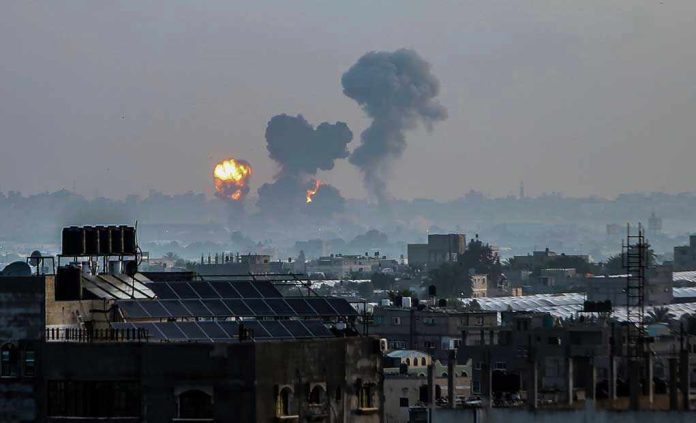
A single cratered arena in Tehran just taught the world a brutal lesson: modern wars don’t only hunt soldiers, they hunt symbols.
Story Snapshot
- A US-Israeli strike destroyed a 12,000-seat indoor arena hall at Tehran’s Azadi Sports Complex, with satellite imagery reported to confirm the damage.
- The strike landed on the sixth day of the 2026 Israel–Iran war, alongside a wider campaign of missiles, drones, and airstrikes across the region.
- Targeting a sports venue signals psychological pressure and strategic messaging, even when the stated focus remains military infrastructure.
- Iran’s leadership succession drama, including pressure around Mojtaba Khamenei, adds volatility to every new explosion and every public statement.
Why a Sports Arena Became a Wartime Message Board
Tehran’s Azadi Sports Complex carries more than crowds; it carries national pride, routine, and the illusion that everyday life can keep breathing during crisis. Reports say a US-Israeli strike destroyed the 12,000-seat indoor arena hall there, a claim supported by satellite imagery circulating in coverage. That matters because an arena is public-facing infrastructure: easy to recognize, easy to mourn, and impossible for a government to quietly hide. The impact lands far beyond concrete.
The military logic, as described in reporting around the broader strike campaign, sits inside escalation math: pressure the opponent’s capacity, signal reach, and shrink the enemy’s sense of safe space. Americans over 40 have seen this playbook evolve from Gulf War “shock and awe” footage to today’s rapid, near-real-time assessment via satellites and social video. The arena’s destruction fits the modern reality: perception management moves as fast as missiles.
Day Six of the 2026 Israel–Iran War: Escalation That Refuses to Stay “Limited”
The arena strike arrived as the war’s sixth day unfolded with expanding strikes on Iranian military and strategic sites, plus continued regional violence involving missiles, drones, and retaliatory attacks. Reporting describes explosions continuing in multiple places, with Israel also widening action tied to Hezbollah in Lebanon and issuing evacuation orders that displaced large numbers of civilians. Wars rarely stay neatly boxed once multiple fronts ignite; they spread along alliances, geography, and pride.
US messaging in the reports frames action as a response to “cumulative threats” and an “imminent indirect threat,” while Pentagon defenses emphasize effectiveness even as casualties occur. That combination—claims of necessity paired with visible loss—creates the political squeeze every democracy recognizes: leaders must prove the strike had purpose, not just motion. The public also demands that “targets” mean something concrete, not vague references that blur into endless conflict.
What the Azadi Strike Suggests About Strategy, Not Just Firepower
Analysts cited in coverage describe the rarity of stadium-type targets and imply psychological impact plays a role alongside operational aims. Common sense says symbolic sites amplify coercion because they impose a social cost: disrupted events, damaged civic identity, and a persistent reminder that the state cannot fully shield normal life. That tactic can shorten wars when it breaks an opponent’s will, or lengthen them when it hardens resolve and fuels recruitment.
From an American conservative values lens, the strongest standard is discrimination and clarity: if a strike ties to legitimate military necessity, leaders owe the public straight talk about why it mattered and how it fits an end-state. Hitting a high-profile civilian-adjacent landmark invites skepticism unless officials connect it to operational purpose. When governments rely on slogans or shifting explanations, they burn trust at home and hand propaganda abroad a gift-wrapped narrative.
The Quiet Fuse Under Tehran: Succession Politics and Institutional Stress
Reporting places the strike inside a moment of internal Iranian turbulence: the death of Ayatollah Ali Khamenei and a contested push toward Mojtaba Khamenei as successor, with friction inside the Assembly of Experts and pressure from the IRGC. Leadership transitions already tempt factional power plays; add external strikes, and the incentive to project strength multiplies. Postponed public rites and emergency sessions reinforce the perception of a regime operating under duress.
That matters for the arena story because symbols work both ways. If Tehran frames the destroyed hall as proof of foreign cruelty, it can rally anger. If rivals inside Iran frame it as proof of leadership failure, it can deepen elite conflict. Americans watching should resist lazy certainty about which path wins; regimes have survived worse. Still, internal dissent combined with battlefield pressure often produces sudden miscalculations—exactly what turns limited war into something wider.
Aftermath: The Human Cost You Don’t See in Satellite Images
Even without confirmed casualty figures tied specifically to the arena strike in the provided reporting, the immediate aftermath is still readable: a major venue removed from public life, sports communities disrupted, and another psychological blow layered onto daily fear—airport closures, blasts, uncertainty, and rumor. War punishes civilians through disruption as much as through direct injury. The older you get, the more you recognize how fast “normal” disappears once utilities, roads, and gathering places fall.
Footage captures the aftermath of an airstrike on Iran's capital that destroyed a 12,000-seat arena in Tehran's Azadi sports complex #Iran #Israel #IranWar #IranIsraelWar #strikes pic.twitter.com/h1mfgP5Xom
— WION (@WIONews) March 6, 2026
Azadi’s destruction also sharpens a question that will shape the next week, not the next decade: what does “success” mean now? If the goal is deterrence, the opponent must believe escalation costs exceed benefits. If the goal is regime pressure, leaders must calculate how much damage produces negotiation rather than chaos. If the goal is simple retaliation, history shows retaliation rarely ends on schedule. The next target choices will answer that.
Sources:
US-Israeli Strike Destroys 12,000-Seat Azadi Stadium Hall in Tehran