A 69-year-old Army veteran known for the “Trump House” died after a brutal Memorial Day weekend assault, and the fight over why it happened now threatens to eclipse what did.
Story Snapshot
- Kerry Sheron, an Army veteran famed for pro-Trump and American flag displays, died after an attack outside his Escondido home [2].
- Police had not released a motive as local coverage unfolded, leaving a vacuum quickly filled by speculation [4].
- Family and friends described the suspect as a transient struggling with mental illness, pushing back on political-motive claims [3].
- The clash between public symbolism and unsettled facts shows how motive inference races ahead of investigations [4].
What Happened And What We Actually Know
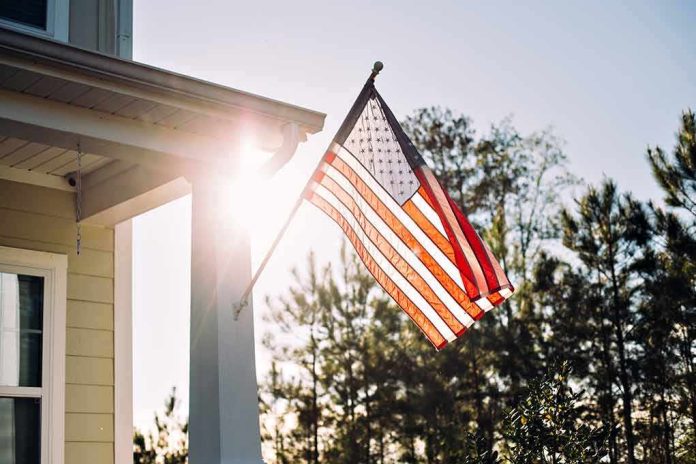
Escondido police responded to a violent assault outside the home widely nicknamed the “Trump House,” where Kerry Sheron displayed prominent Trump and American flags. Sheron suffered critical injuries and later died, according to local television reporting that identified him as a community fixture for his patriotic displays [2]. Court coverage confirmed a suspect was charged and pleaded not guilty as the case moved forward, but investigators had not publicly disclosed a motive at the time of those reports [4]. That gap seeded a narrative tug-of-war over what the attack meant.
Local on-scene and follow-up reports framed the house’s political visibility in vivid terms—big flags, bold signs, and a homeowner known for it—ensuring that politics became the immediate lens, even before facts about motive emerged [2]. This is the modern sequence: a high-visibility symbol, a violent act, and then instant speculation. While some coverage described the residence as celebrating former President Donald Trump, the same newscasts emphasized the absence of a stated motive from police, which should have slowed the train. It did not [4].
The Counter-Narrative From People Close To The Scene
Friends and family quoted in local segments contested the political angle, pointing to the suspect’s erratic behavior and apparent mental health problems rather than partisan targeting. One segment described the man as a transient, reportedly “yelling in the air,” which supports a nonpolitical interpretation consistent with a person in crisis, not an ideologue on a mission [3]. This account matters because it meets a common-sense test: when motive is unknown, firsthand observations of instability deserve weight until the investigation produces clear evidence to the contrary.
Coverage also captured the procedural reality: the suspect pleaded not guilty and the investigation continued without an official motive, according to station reporting that tracked the early legal steps and public statements. That judicial posture is normal in serious violent-crime cases and underscores why restraint around motive claims protects both the truth-finding process and public trust. Premature conclusions harden quickly and rarely unwind cleanly, especially when political iconography is involved [4].
How Symbolism Short-Circuits Patience
High-profile symbols accelerate meaning-making. A home filled with Trump displays creates a narrative shortcut for audiences predisposed to see political violence everywhere, just as the absence of a declared motive invites others to wave politics away. Both impulses collide in the information void after a tragedy like this. The first claim invokes a culture-war script; the second leans on the mental-illness frame. Neither satisfies the burden of evidence when police have not publicly stated why the attack occurred [4].
Owner of Escondido ‘Trump House’ dies from injuries suffered in assault https://t.co/jmSrlqOlhI
I used to honk everutime i drove past his house if he was outside he always waved to Trump fans that would honk. I am so sad that tjis happened!
— Alicia C.C. (@ChicasSarcasm) May 26, 2026
Conservative priorities align with a disciplined approach here: insist on evidence, protect due process, and hold media to clarity over conjecture. If facts later show politics played a role, call it what it is and demand equal outrage, equal justice, and consistent coverage. If the record shows a mental-health-driven crime, focus on accountability, public safety, and the policy failures that let unstable, dangerous behavior roam unchecked. Either way, truth should govern the narrative, not the volume of the loudest storyline [3].
Sources:
[2] YouTube – Escondido ‘Trump house’ owner dies after brutal attack
[3] YouTube – Escondido man hospitalized after attack outside his Trump-themed …
[4] Web – Escondido ‘Trump House’ owner dies after assault – 10News.com