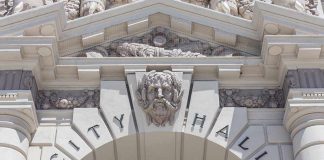
New York City Mayor Zohran Mamdani stood at George Washington’s desk on July 3, 2026, and told a room full of newly naturalized citizens that true patriotism means confronting America’s flaws — then watched the political world explode around him.
Story Snapshot
- Mamdani delivered a nearly 13-minute July 4 address from City Hall, seated at the historic desk where George Washington once worked, flanked by new American citizens holding small flags.
- He defined patriotism as “every act of righteous dissent” and argued that loving America means demanding it live up to its founding ideals.
- The speech hit hard on immigration, blasting what Mamdani called an “arena of supremacy” and accusing Immigration and Customs Enforcement agents of terrorizing New York neighborhoods.
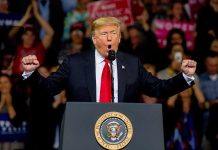
- President Trump called him a “communist,” the New York Post ran a hammer-and-sickle image on its front page, and conservative media lit up with some of the harshest language of the summer.
- Mamdani has since pushed back on critics, insisting the speech was a love letter to America — not an attack on it.
What Mamdani Actually Said at City Hall
The speech was not subtle. Mamdani opened by invoking 250 years of what he called “a grand experiment in self-governance, an experiment so audacious that some in 1776 doubted it would last.” He then turned that founding pride into a launching pad for sharp criticism. He called out “oligarchs” buying elections, accused masked federal agents of invading neighborhoods, and named Elon Musk by association. He also praised immigrants as the nation’s greatest resource, directly challenging the idea that America “becomes less” with each new arrival.
The setting was deliberate. Sitting behind George Washington’s desk — the same Federal-style desk used when Washington was sworn in as president — Mamdani surrounded himself with immigrants from Mexico, Haiti, and Pakistan, all recently naturalized, all holding American flags. It was a visual argument as much as a verbal one. The message: these people are America, and their presence makes the country stronger, not weaker.
The Line That Set Off the Firestorm
One sentence became the flashpoint. “Patriotism has never been about pretending our nation is without flaws. Patriotism is every act of righteous dissent.” To his supporters, it was the speech of the summer. To his critics, it was proof he hates the country he now helps govern. Conservative outlets ran with the most inflammatory framing possible. The Twitchy headline called him a “Little Commie” and summarized the speech as “America Sucks.” Trump, speaking from Miami, used the word “communist” without hesitation.
Here is where common sense matters. Calling a speech that opens with praise for America’s 250-year democratic experiment an “America Sucks” address is a stretch. Mamdani explicitly said, “It is precisely because we love this nation that we will not leave it.” You can disagree hard with his politics — and there is plenty to disagree with — but the “he hates America” framing is more about winning a news cycle than describing what he actually said. The communist label, applied to a sitting mayor who won a democratic election, is a rhetorical weapon, not an analysis.
Where Mamdani’s Argument Has Real Weaknesses
The speech had genuine gaps that critics could have targeted more precisely. Mamdani referenced Selma and Seneca Falls as examples of national flaws, but never explained what happened at those places or why they matter. He claimed America grows stronger by welcoming immigrants but offered no data to back it up. He attacked Immigration and Customs Enforcement agents without distinguishing between lawful enforcement and abuse. Those are fair targets for pushback. Instead, critics mostly swung at the framing rather than the substance, which let Mamdani’s team play defense on easy ground.
New York City Mayor Zohran Mamdani is currently facing widespread backlash for a series of recent statements and policy directives, most notably his urgent call for residents and businesses to set their air conditioning to 78°F during a severe heat wave, his declaration that he…
— Leinona Aoki (@LeinonaA69) July 3, 2026
The backpedaling, such as it was, consisted mostly of Mamdani repeating that the speech was an act of love. That is consistent with what he actually said on July 3. He also called collectivism a replacement for “rugged individualism,” which is a genuine policy difference worth debating on its merits. His record in office — including threats to raise New York City property taxes and his public praise for figures tied to anti-Israel activism — gives critics real material to work with. The July 4 speech, read in full, is the least of it.
Why This Fight Keeps Happening Every Election Year
This is not the first time a politician has been called a traitor for criticizing America in a patriotic speech, and it will not be the last. The pattern is old and well-worn: one side frames dissent as disloyalty, the other frames silence as complicity. Mamdani’s speech fits squarely in a tradition that runs from Frederick Douglass to Ronald Reagan’s own acknowledgment that America must always strive toward its ideals. The difference is the policy agenda attached to the words. Mamdani is a democratic socialist running in one of the most watched mayoral races in the country. His speech was a campaign document dressed in founding-era language. Voters in New York — and observers everywhere — should read it that way, with clear eyes and no blinders on either side.