The most shocking part of this case is not the 112 mile per hour impact, but what the driver did afterward.
Story Snapshot
- Driver Mario Bickham is charged with two counts of murder for a 112 mile per hour freeway crash that killed an on-duty Los Angeles Police Department sergeant and a Whole Foods worker.[2][4]
- Prosecutors say he was speeding over 100 miles per hour and had a history of extreme speeding tickets and prior crashes.[2][3][4]
- Media reports say he held a fundraiser for himself after the deadly crash, raising hard questions about personal responsibility and remorse.[5]
- The case lands in the middle of a growing national debate over deadly police pursuit crashes and how the law should treat reckless drivers who flee.[10][13][17]
How a late night freeway stop turned into two deaths and a murder case
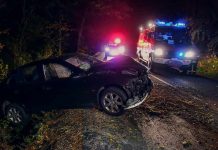
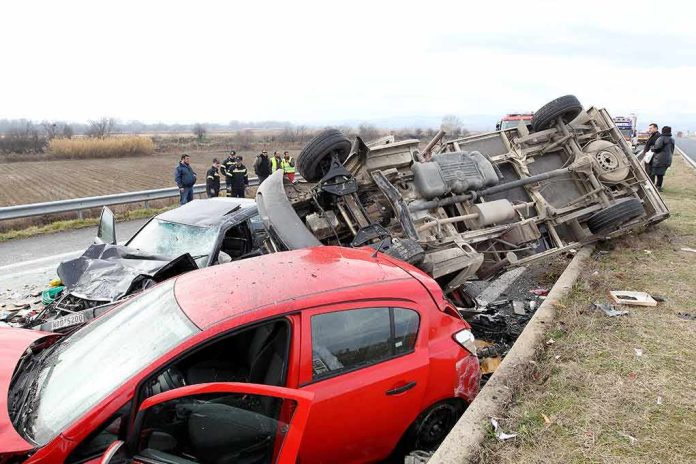
Just after 2 a.m. on June 23, 2025, a simple act of helping a stranded driver turned into a scene that prosecutors now call murder. Jesus Garcia, a 34-year-old Whole Foods worker, was heading home when a hit-and-run driver disabled his pickup in the high-occupancy lane of the 405 Freeway near the Getty Center. Los Angeles Police Department Sgt. Shiou Deng pulled over with lights and siren to help Garcia, stepping out of his patrol vehicle to protect him and guide traffic around the hazard.[2][3][4]
According to court records, 33 other cars managed to pass that scene safely. Then, prosecutors say, Mario Joseph Bickham approached in his car at about 112 miles per hour, covering almost half a football field every second. At that speed, there was no chance to react. His vehicle slammed into Deng’s patrol sports utility vehicle, then struck Garcia, who was standing outside his truck. Both men died from the impact, leaving families and co-workers stunned that a routine drive home could end like this.[1][3][4]
Why prosecutors called this murder and not just a tragic accident
Los Angeles County District Attorney Nathan Hochman did not treat this as a normal crash. His office charged Bickham, 36, with two counts of murder, a step usually reserved for intent to kill or extreme disregard for human life. The key word here is “implied malice,” the legal idea that driving over 100 miles per hour toward flashing police lights and a known hazard shows a conscious choice to ignore the risk to others. That fits a pattern where more prosecutors now treat extreme reckless driving deaths as second-degree murder, not manslaughter.[1][2][3][4]
Court filings also point to Bickham’s past on the road. Just one month before the crash, a California Highway Patrol officer ticketed him for driving 105 miles per hour. Records list multiple prior crashes dating back to 2014, though he had no other criminal history. To many Americans, especially those who value law and order, this looks less like “bad luck” and more like a long warning trail. When a person keeps pushing the speed needle into triple digits, common sense says a deadly outcome stops being a surprise.[2][3][4]
The fundraiser that turned outrage into a political firestorm
Then comes the part that made this case explode in public anger. The New York Post reported that after the crash, Bickham held a fundraiser for himself. That detail, more than any court filing, shaped how millions saw the story. To a typical reader, asking for money while families bury a police sergeant and a grocery worker feels like rubbing salt in an open wound. It raises blunt questions: was this man worried more about his own bills than the lives he ended?[5]
Defense lawyers might argue there is another side. They may say the fundraiser covered medical costs or legal fees, that a panicked, injured man did what many suspects do in a system where one mistake can mean life in prison. But the lack of clear public rebuttal so far gives the “self-fundraiser” image free space to grow. In a culture that prizes personal responsibility, that image feeds a narrative of selfishness and weak remorse. That narrative can matter as much as any piece of forensic evidence when jurors and judges weigh punishment.[5]
How this crash fits a larger crisis of deadly police pursuits
This case does not happen in a vacuum. Across the United States, police pursuits and high-speed crashes kill thousands. One study found at least 3,336 people died in police car chases between 2017 and 2022, with about 30 percent of those deaths being innocent bystanders. The Department of Justice has called vehicle pursuits “the most dangerous” ordinary police activity. Many of these deadly events start with nonviolent offenses, then turn lethal once a driver decides to flee and floor the gas pedal.[10][12][13][14][17]
Policy experts now push departments to limit chases to violent suspects who pose an imminent threat. That debate matters in the Bickham case because it draws a line between two kinds of blame. On one side is the driver, who chooses reckless speed and, according to prosecutors, ignores both common sense and other people’s right to get home alive. On the other side is the system that still sees high-speed responses and freeway stops as normal tools, even when research shows these tactics raise death risks for regular families on the road.[2][4][11][12][13][16][17]
What common sense, conservative values, and public anger collide over here
For many conservative Americans, this case hits two core beliefs. First, individuals must own the results of their choices. Driving over 100 miles per hour on a crowded freeway, with past tickets for doing the same, looks like a string of reckless decisions, not one unlucky night. When those choices kill a police officer serving his community and a blue-collar worker heading home, calling it murder matches a gut sense that some lines cannot be crossed without severe consequences.[2][3][4]
Second, people want a justice system that protects innocent lives, not just punishes after the fact. High-speed pursuits and roadside stops that expose stranded drivers to extreme danger make many ask whether policies really put public safety first. Still, this particular case centers more on Bickham’s speed and history than on police tactics. The fact that 33 cars passed safely suggests the main trigger was one driver’s refusal to slow down. No policy can fully shield the public when one person treats a freeway like a private racetrack.[1][10][12][15][16][17]
Sources:
[1] Web – Driver who held fundraiser for himself after killing LAPD cop and …
[2] Web – Family and fellow delivery drivers gathered to honor his life. Click …
[3] Web – Driver who held fundraiser after killing LAPD cop and Whole Foods …
[4] Web – Second-Degree Murder Charges Issued Against Driver Who Fled …
[5] YouTube – Family of DC delivery driver killed in police chase demands justice
[10] Web – Former LaSalle officer pleads guilty to manslaughter for killing man
[11] Web – Mycobacteria-Specific T Cells Are Generated in the Lung During …
[12] Web – Mario Bickham – Actor/Producer | Retired LEO – LinkedIn
[13] Web – Offense has to score TDS defense keeping us in the game today
[14] Web – [PDF] SOCIAL MOVEMENTS
[15] Web – [PDF] oss personnel files – rg 226 entry 224
[16] Web – [XLS] USACE Database
[17] Web – Fiona!! Our 8th grade student highlight of the week. She said in her …