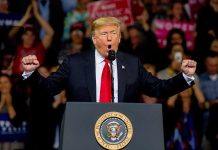
Donald Trump Jr. walked out of the Charlie Kirk murder hearing saying the evidence “left little room for doubt” — and the fight now is over whether that feeling matches what was actually put on the record in court.
Story Snapshot
- Surveillance, DNA, and a text to an ex-lover form the core case against Tyler Robinson.
- Defense lawyers attacked the DNA work and got key video tossed, shaking that neat picture.
- Recorded statements from a roommate and romantic partner with immunity raised hard questions about trust.
- The clash between Trump Jr.’s certainty and courtroom nuance shows how political violence gets weaponized.
What Trump Jr. Saw, And Why It Felt So Convincing
Donald Trump Jr. sat in the same courtroom where jurors will one day hear how prosecutors say Tyler Robinson stalked and killed Charlie Kirk on a Utah campus. He watched surveillance clips of Robinson moving across campus, climbing to a rooftop, and crouching over the amphitheater where Kirk spoke. He heard about a rifle found nearby and a towel with DNA linking back to Robinson and his former roommate and lover, Lance Twiggs. He listened as the state said Robinson confessed in writing, telling Twiggs he “had the opportunity to take out Charlie Kirk.” For a lay observer who already fears rising political violence, that chain of moments can feel like a closed box: the suspect is on the roof, the gun is recovered, the DNA connects, the text admits motive. Add the emotional shock of seeing Kirk’s widow Erika and his parents facing the accused, and it is easy to walk outside and tell cameras, as Trump Jr. did, that the case looks almost airtight.
Trump Jr. also focused on something bigger than one defendant: the way the system handled a high-risk event before the shots were fired. He publicly blasted Utah Valley University after learning only a handful of officers were on duty and there had been no serious security briefing before Kirk’s appearance. For conservatives who see campuses as hostile to their speech, those details ring like an alarm bell. They support a narrative that right-of-center voices are both targeted and under-protected. So when Trump Jr. pairs strong-looking evidence against Robinson with a story of weak campus security, he frames the hearing as proof of a larger pattern: powerful institutions failed to safeguard a friend, and now only a tough prosecution stands between order and chaos.
The Evidence Inside The Courtroom: Strong Story, Fragile Edges
Strip away the TV sound bites, and the actual evidence is both substantial and contested. Former State Bureau of Investigation agent David Hull laid out a detailed timeline built on campus surveillance. He said Robinson came to the university four separate times that day, visited the amphitheater before the event, spoke with Turning Point USA staff, changed clothes, and later climbed onto the Losee Building roof to reach a firing position. Investigators then found a rifle in a wooded area along a route they say Robinson took as he fled, wrapped in a towel that carried DNA from Twiggs and “very likely” Robinson, according to a state analyst. Prosecutors added the alleged written and text confession to Twiggs, where Robinson supposedly said he was going to “take out” Kirk because he had “had enough of his hatred.” On top of that, Robinson surrendered to authorities less than two days after the shooting, arriving with his parents and a family friend. On paper, that looks like classic circumstantial but powerful evidence: motive, means, opportunity, and flight. It is the kind of package that makes political allies like Trump Jr. comfortable saying “there is no doubt,” especially when they trust law enforcement more than defense lawyers.
The trouble is that courtrooms run on standards, not vibes. Defense attorney Michael Burt went straight at the DNA, pressing Federal Bureau of Investigation (FBI) analyst Amanda Bakker on her methods. By his telling, the testing could not cleanly separate Robinson’s profile from the questioned samples at several key points. “She can’t match Mr. Robinson to the questioned samples,” Burt argued, undercutting the simple headline that “DNA proves” Robinson handled the rifle. Judge Tony Graf then threw another wrench into the clean narrative by excluding a critical surveillance video because prosecutors had added zooms and visual effects. That does not erase what Agent Hull saw in the raw footage, but it does mean one of the prosecution’s strongest pieces of visual proof is, for now, off-limits in its edited form. When the state leans heavily on a confession to a lover who was granted immunity for his statements, and on video the judge has already ruled problematic, the case stops looking like a slam dunk and starts looking like a serious but testable theory, even for conservatives who value law and order.
Confessions, Immunity, And The Problem Of Trust
The most explosive part of the hearing did not come from a lab report. It came from the private world of a shared apartment and secret romance. Prosecutors say Twiggs was both Robinson’s roommate and romantic partner, and that he received a note and later a text in which Robinson admitted planning and carrying out the attack on Kirk. Twiggs did not testify live at the preliminary hearing, despite efforts by the defense to compel him to travel to Utah. Instead, jurors and the public are getting his account through recorded interviews and statements. That alone raises fairness questions: cross-examination is the backbone of American justice, and people granted immunity to talk to police sometimes shade facts to protect themselves. Judge Graf allowed use immunity for Twiggs, meaning his statements cannot be used to prosecute him, which keeps the door open for the defense to later attack his motives. For many right-leaning Americans, this is where common sense kicks in. If a man avoids charges by telling investigators what they want to hear about a close partner, his story must be treated carefully, even if it supports a conservative victim. Confessions filtered through romance, heartbreak, and legal bargaining are messy. They may be true, they may be partly true, but they are never neat. Trump Jr.’s certainty downplays that complexity. The hearing record does not show a clear video confession or lengthy, unchallenged testimony from Twiggs. It shows snippets, immunity, and a defense team eager to cross-examine in full.
This is exactly why the Charlie Kirk case is moving so fast in court right now.
Donald Trump Jr. just left the preliminary hearing and said the evidence surveillance footage, DNA, and testimony makes the case “very cut and dry.” He also pushed back hard on the online conspiracy…
— 𝐌𝐈𝐂𝐇𝐀𝐄𝐋 𝐎𝐋𝐈𝐏𝐇𝐀𝐍𝐓 (@MichaelOliphant) July 10, 2026
All of this unfolds inside a country already on edge about political violence. In just the last few years, Americans have watched assassination attempts and attacks aimed at figures on both the right and the left, from congressional Republicans at baseball practice to Supreme Court Justice Brett Kavanaugh. Experts say modern social media turns every high-profile killing into fuel for polarized narratives, even before a jury ever hears the case. Conservative audiences hear about Kirk’s death and see proof of growing hatred against them. Liberal audiences hear about disputed DNA, altered video, and immunity deals and see another reason to distrust law enforcement in politicized cases. The hard truth is that the preliminary hearing did not deliver a final answer. It delivered a strong circumstantial case with real holes that a jury will have to weigh. From a conservative, rule-of-law point of view, the honest stance is this: the evidence against Robinson is serious and deserves to be tried fully, but real doubt or real certainty belongs with a jury after clean video, vetted forensics, and live, cross-examined witnesses are all finally on the table.
Sources:
facebook.com, cbsnews.com, foxnews.com, apnews.com, abc7chicago.com, bbc.com, youtube.com, reddit.com, abc7ny.com, cato.org, ctc.westpoint.edu