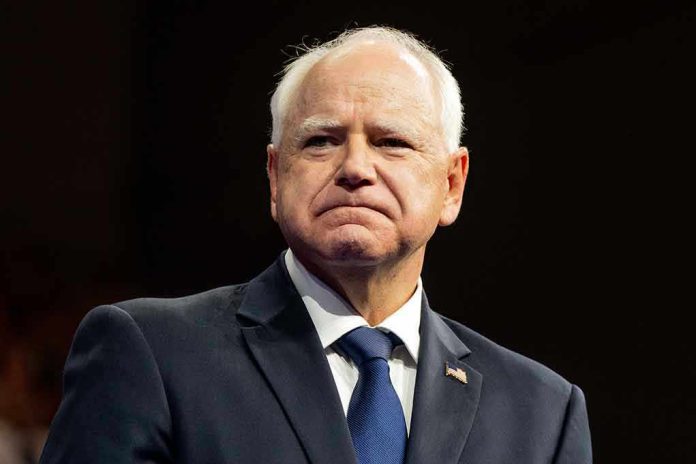
Minnesota Governor Tim Walz and the state’s Board of Pardons voted unanimously to pardon Tou Lue Vang, a man who pleaded guilty to first-degree criminal sexual conduct against a 10-year-old child — a decision that cleared his record and gave him a legal foothold to fight deportation.
Story Snapshot
- The Minnesota Board of Pardons, led by Gov. Tim Walz, unanimously pardoned Tou Lue Vang, who pleaded guilty to sexually abusing a 10-year-old girl over multiple incidents.
- Vang avoided prison time through a plea deal and faced deportation to Laos before the pardon cleared his record.
- The victim sent a letter supporting the pardon, and the nine-member Clemency Review Commission endorsed it in April 2026.
- The Department of Homeland Security blasted the decision, saying the pardon could block a valid deportation order tied directly to Vang’s sex offense conviction.
What the Board of Pardons Actually Did
On June 10, 2026, the Minnesota Board of Pardons voted to pardon Tou Lue Vang, 42, who came to the United States as a child from Laos. Vang had pleaded guilty to first-degree criminal sexual conduct for repeatedly abusing a girl who was 10 years old when the offenses began. A plea agreement allowed him to avoid prison time. His conviction triggered a deportation order, and the pardon effectively wiped that conviction from his record, giving him a legal basis to challenge his removal.
The board that voted on this pardon is made up of three people: Governor Walz, Attorney General Keith Ellison, and Minnesota Supreme Court Chief Justice Natalie Hudson. All three voted yes. The nine-member Clemency Review Commission had already recommended the pardon in April 2026, with four members in favor and two against. The board is not required to follow the commission’s recommendation, but it did — without hesitation.
The Victim’s Letter and What It Does and Doesn’t Mean
Attorney General Ellison’s office told The New York Times that the victim herself sent a letter endorsing the pardon. That detail matters, and it deserves honest acknowledgment. Victim input is a legitimate part of any clemency process. But a victim’s forgiveness, as meaningful as it is personally, does not erase the public safety question at the center of this case: whether a man who committed repeated child sexual abuse should be shielded from federal immigration enforcement through a state pardon. Those are two separate questions, and conflating them is a mistake.
Federal Government Pushes Back Hard
The Department of Homeland Security (DHS) did not hold back. DHS Acting Assistant Secretary Lauren Bis confirmed that Vang lost his legal status specifically because of his conviction for the repeated sexual assault of a 10-year-old girl. Bis stated the pardon was designed to cancel the very conviction that formed the basis of his removal order. DHS called the move an obstruction of federal immigration enforcement and accused Minnesota officials of prioritizing criminal aliens over American citizens.
The three-person Minnesota Board of Pardons:
Gov. Tim Walz
A.G. Keith Ellison
Chief Justice Natalie HudsonUnanimously granted this child rapist a pardon.
He was being fast-tracked for deportation because of the conviction. https://t.co/VL0mvzIKV4
— Sean Nienow (@SNienow) July 2, 2026
This is not the first time Minnesota’s Board of Pardons has moved quickly to pardon a noncitizen facing deportation. The board also unanimously pardoned Jai Vang, a Laotian man convicted of aggravated robbery in 1994, just weeks before Tou Lue Vang’s pardon was approved. In a separate case, the board pardoned Xayasounethone Chandee, a Laotian national with multiple assault convictions. DHS blasted that decision too, warning it could block a long-standing deportation order. A pattern is forming, and it is hard to see it as anything other than a deliberate strategy.
The Legal Reality Behind State Pardons and Deportation
Here is what the law actually says. For most criminal convictions, a state governor’s pardon erases the conviction for immigration purposes and can block deportation tied to that offense. But a pardon does not guarantee the person stays in the country. Federal immigration judges still have discretion, and the Department of Homeland Security can pursue removal on other grounds. The pardon gives Vang a legal argument, not a guaranteed outcome. Still, it hands him a significant weapon in immigration court that he would not otherwise have.
The Bigger Question Minnesota Is Dodging
Governor Walz said publicly that immigration status alone is not a reason to grant a pardon. That sounds reasonable in the abstract. But in practice, the board has now rushed through multiple pardons for Laotian nationals facing imminent deportation — including a child sex offender — in a matter of weeks. The timing, the speed, and the pattern tell a story that the board’s stated reasoning does not fully explain. When the offense involves a child victim and the pardon’s primary practical effect is to block federal deportation, the public deserves a much harder look at what is actually driving these decisions.