Bernie Sanders’ toughest climate problem isn’t a Senate vote—it’s the tailpipe of his own campaign travel.
Quick Take
- A watchdog group calculated 62.15 metric tons of CO2 tied to Sanders’ 16-stop “Fighting Oligarchy” tour with Rep. Alexandria Ocasio-Cortez.
- Federal Election Commission filings for 2025 show Sanders spent over $550,000 on private jet travel that year.
- Sanders defended the flights as the only workable way to hit a high-volume rally schedule, rejecting calls to apologize.
- The campaign’s use of carbon offsets raises questions about whether offsets match private-jet reality or just political optics.
The Number That Turned a Tour Into a Liability
Power the Future’s May 2025 report didn’t accuse Sanders of vague “overuse” or “excess.” It put a hard figure on the problem: 62.15 metric tons of carbon dioxide for a 16-stop swing. Numbers like that stick because they translate into everyday scale—years of emissions compressed into weeks. For a politician who sells climate urgency as moral clarity, arithmetic like this creates a story his opponents don’t have to embellish.
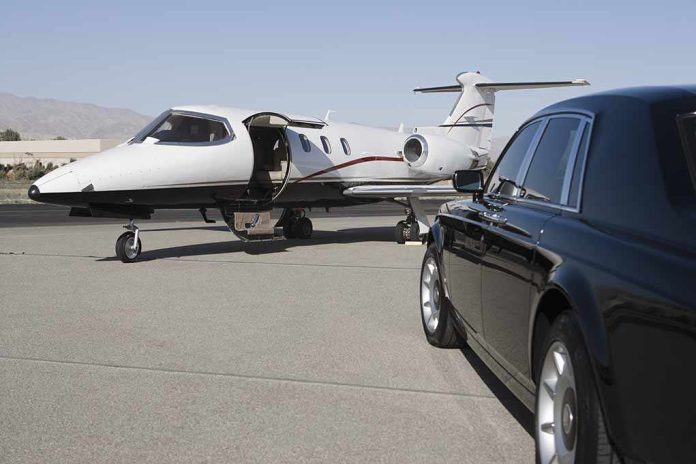
The pairing with Ocasio-Cortez sharpened the contrast. Two of the most recognizable champions of aggressive climate policy traveling by one of the most carbon-intensive options is the kind of image that outlives any press statement. Critics also seized on the luxury angle, including the reported use of a Bombardier Challenger class jet, an aircraft category associated with high hourly operating costs rather than thrift or restraint.
What the Filings Say: Private Jets as a Repeated Campaign Line Item
The money trail matters because it shows pattern, not a one-off “schedule emergency.” FEC filings cited in 2025 coverage show Sanders spent more than $550,000 on private jet travel during that calendar year, with payments routed through private aviation vendors. That figure lands differently for voters who hear constant speeches about inequality and sacrifice. Campaigns cost money, but private jets look like a choice, not a tax.
Sanders’ jet history also predates this tour. Reporting on earlier cycles described private jet use during the Clinton surrogate period and continued spending after the 2016 election. By 2020, his presidential campaign’s private-jet spending rose into the millions. None of this proves illegality or even unusual behavior in modern politics, but it does undercut a central sales pitch: that the rules should tighten for everyone else while leaders model the standard.
The Defense: “No Apologies” Meets the Reality of Commercial Alternatives
Sanders’ response to questioning was blunt: he framed private aviation as the only way to keep up with a schedule of multiple rallies a week, arguing commercial travel would trap him in airport lines instead of in front of large crowds. That defense will sound practical to anyone who has watched modern campaign logistics up close. The problem is that practicality isn’t the same thing as consistency—especially when the politician argues the country must reorganize life around emissions.
The counterargument doesn’t even require a partisan imagination. At least one route highlighted in the public back-and-forth—Washington, D.C., to Los Angeles—has ample commercial options daily, suggesting private flights weren’t always a last resort. The strongest critique, from a common-sense perspective, isn’t “never fly private.” It’s that climate leaders should prove they tried the inconvenient options before demanding inconvenience from families, workers, and small businesses.
Private Jets and Carbon Math: Why This Isn’t a Small Optics Problem
Environmental researchers have long warned that private jets carry a uniquely bad emissions profile per passenger. A 2021 report frequently cited in coverage put private jets at up to 14 times more polluting than commercial planes on a per-passenger basis. That multiplier is the hidden engine of the controversy. Even if a campaign team insists it’s “just travel,” the climate movement itself treats transportation choices as moral signals and policy justifications.
This is where the story becomes bigger than Sanders. Climate politics depends on trust: voters accept higher costs, new regulations, and lifestyle constraints when they believe leaders share the burden. When high-profile advocates appear to carve out exceptions for themselves, they don’t merely irritate skeptics; they convert persuadable middle voters into cynics. Conservative values tend to reward fairness and accountability, and this episode reads like rules for thee, not for me.
Offsets as a Get-Out-of-Emissions Card? Not So Fast
The Sanders campaign has used carbon offsets, including a reported purchase in a prior cycle from Native Energy. Offsets can play a legitimate role in emissions accounting, but they also invite a hard question: do they reduce carbon, or do they reduce guilt? Even supporters struggle to explain offsets simply because the public knows they’re not the same as not emitting in the first place, especially with high-emission private aviation.
Another practical issue dogs offsets in this context: calculators and offset programs may not capture the true emissions intensity of private jets compared with commercial seat-sharing. If the method treats a private flight like a regular passenger ticket, the math becomes comforting but questionable. Offsets may help, but they don’t erase the underlying contradiction of preaching emergency while choosing the most emissions-heavy travel tool for convenience.
The Real Damage: A Credibility Gap That Swallows the Message
Opponents predictably pounced, labeling Sanders and allies with terms like “champagne socialists,” while Power the Future framed the episode as evidence that the climate movement’s leaders don’t believe their own alarms. The smarter takeaway for readers isn’t the insult; it’s the vulnerability. Climate policy is already a hard sell when it raises energy prices or threatens jobs. Add elite exemptions, and the message starts to sound like social control rather than stewardship.
Sanders could reduce this problem overnight with a standard that matches his rhetoric: default to commercial, publish travel rationale when private is unavoidable, and disclose offset methodology in plain English. That would feel like leadership rather than damage control. Until then, every climate speech risks reopening the same loop in voters’ minds: if the crisis is existential, why does the solution always start with everyone else?
Sources:
Energy Watchdog Exposes Eye-Popping Carbon Footprint of Sanders’ Jet-Setting Tour
Bernie Sanders Spends Thousands More on Private Jet Travel
Bernie Sanders repeatedly requested private jet flights during Clinton campaign
Bernie Sanders spent over $550K in 2025 campaign funds on private jets, filings show
Bernie Sanders spent over $550K in 2025 campaign funds on private jets, filings show