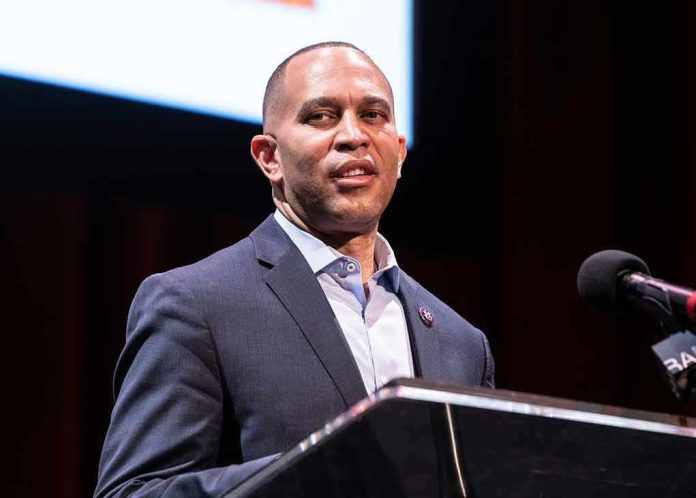
Hakeem Jeffries accused Democratic Socialists of America of racial exclusion while their activists jeered him, and that charge now shapes a deeper fight over who controls the Democratic Party.
Story Snapshot
- Jeffries says Democratic Socialists of America treat him with racial bias and hostility.
- Socialist leaders answer that their dispute is about money, power, and policy, not race.
- This clash sits in a long struggle between party insiders and activist reformers.
- The outcome will steer how Democrats handle class, race, and coalition power.
Jeffries turns a jeer into a line in the sand
Hakeem Jeffries drew a bright line with Democratic Socialists of America after activists cheered his political setbacks. He framed their opposition as racially exclusionary and hostile to his leadership. His past comments show a steady rift with the socialist left and a pledge to hold hard-liners to account. He told ABC’s This Week that Democrats include “different ideological persuasions,” while pushing for accountability against what he calls wrongdoers tied to extremism. That stance sets the baseline for today’s fight.
Jeffries’s critics on the socialist left argue the feud is not about race. They say it is about policy and power. A New York City Democratic Socialists of America co-chair said Jeffries chases corporate money instead of helping working families, a claim that defines their frame for the conflict. Another report said many socialists view him as a standard party insider, pointing to his stance on health care and support for Israel as core reasons for their pushback.
Socialists say class war; Jeffries says exclusion
Jeffries’s team views the activist base as trying to displace long-standing Black political power in Brooklyn. A Central Brooklyn consultant said many Black residents feel their voice is being pushed aside by a group without roots in the community. That fear feeds Jeffries’s claim of racial exclusion. A close observer of the feud traced years of bad blood, with both sides trading shots over machine politics, insurgent primaries, and neighborhood control. The frame is personal, local, and very much about who decides who represents whom.
Socialist leaders reject the racism label and center their argument on class and corporate power. Newsweek quoted an analyst who said Democratic Socialists of America has not put white supremacy at the core of its politics, which, if true, weakens the racism charge at the national level. That does not negate local tensions over race and representation. It does show a split screen: national ideology versus neighborhood trust. Voters will judge which lens feels truer to daily life.
A familiar Democratic brawl with 21st-century stakes
Party insiders and activist reformers have fought over control for decades. Scholars of Democratic Party history describe long cycles of tug-of-war after 1968, with activists demanding more voice and professionals focused on coalitions that can win and govern. The socialist revival also has a long lineage, and it tends to produce internal factions and recurring fights over tactics, priorities, and candidates. This is the same movie, but with different stars and faster social media.
Racial identity adds heat to class fights. Research shows that when protest language targets “whiteness,” support among White Democrats drops, and people distance from the protesters. That dynamic explains why a racial-exclusion charge, even if disputed, lands hard. It rallies some voters and repels others. Media habits also amplify conflict frames and turn crowd moments into team sport, making compromise feel like a loss, not a win. Leaders who want big-tent politics must swim against that current.
Where common sense lands now
No one disputes that Jeffries and Democratic Socialists of America are at odds. The facts point to clashing worldviews on economics, Israel, and the role of party structures. The racism claim is harder to prove at the national leadership level of Democratic Socialists of America, where even critics say white supremacy is not their central theme. Yet local Black communities in Brooklyn report a real worry about displacement and voice, which gives weight to Jeffries’s alarm about exclusion. Both things can be true at once.
He wanted a slim win so Speaker Hakeem Jeffries would need to compromise with far leftist and DSA members. They've been rendered irrelevant because of the historic gains nationwide orchestrated by Jeffries and Chuck Schumer. pic.twitter.com/MHxIzJls8O
— Fly Sistah 🪷 (@Fly_Sistah) November 9, 2026
Senator Raphael Warnock framed the chants and taunts as loud family arguments, not a racial war, and pushed the focus back to the needs of ordinary people. That is a sane north star. The practical test is simple: who can deliver on costs, safety, and opportunity while keeping a broad coalition together. On that score, the side that talks less about purity and more about results usually wins. Jeffries is betting that most voters agree. Socialists are betting the moment demands sharper edges.
Sources:
twitchy.com, jeffries.house.gov, houstonpublicmedia.org, abcnews.com, npr.org, newsweek.com, rosselliotbarkan.com, peoplesworld.org, english.elpais.com, legalinsurrection.com, yahoo.com