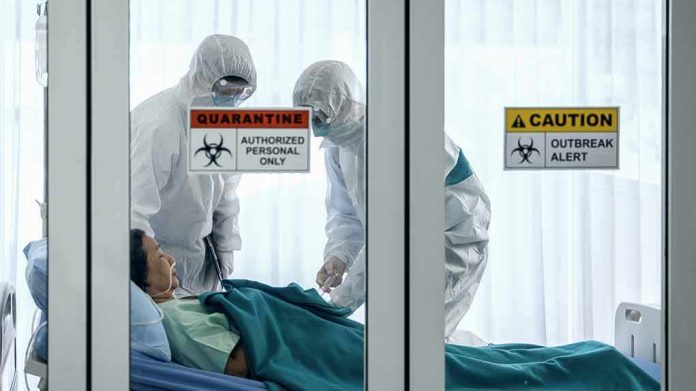
Doctors on the front lines say Ebola is now racing ahead of them, turning a regional health emergency into a test of whether the world still has the will and the means to stop a deadly virus before it breaks loose.
Story Snapshot
- World Health Organization leaders warn the Bundibugyo Ebola epidemic is spreading faster than current response efforts.
- There is no approved vaccine or targeted treatment for this strain, leaving doctors to rely on basic supportive care.
- Africa-wide and international aid plans seek hundreds of millions of dollars to close gaps in surveillance, staffing, and supplies.
- Conflict, remote terrain, and weakened health systems make late detection and rapid spread more likely, even with new aid.
Doctors sound the alarm as Ebola outruns containment
Health workers in the Democratic Republic of the Congo are telling a blunt story: Ebola cases are rising faster than they can respond. The Bundibugyo species of Ebola virus has infected more than 1,700 people and killed about 600 in the DRC alone, according to United Nations relief officials. World Health Organization leaders say the latest epidemic is now spreading faster than health workers can contain it, with suspected and confirmed cases spiking across several provinces. That speed matters, because every missed case creates a new chain of transmission that can double or triple in days. Doctors report patients arriving late to treatment centers, often with high viral loads and organ failure, which points to weak early detection and delayed care at the community level.
The warning is not just local. The International Rescue Committee says the outbreak is “spreading faster than the response” and could become the deadliest Ebola crisis on record without urgent action. Cases have moved beyond the original epicenter in Ituri into North Kivu, South Kivu, and neighboring Uganda, including key transport hubs such as Bunia, Goma, and Kampala. World Health Organization doctors now talk about the virus spreading “faster and more widely than previously thought,” as investigations uncover infections in new towns and cities. When eighty percent of new cases appear outside known chains of transmission, as one report notes, that is a red flag that surveillance and contact tracing are being outpaced by real-world spread.
A dangerous strain with no approved vaccine or treatment
This outbreak is driven by the Bundibugyo strain of Ebola, a rarer species that poses a cruel twist for modern medicine. Unlike Zaire Ebola, which has licensed vaccines and some therapeutic options, Bundibugyo has no approved vaccine and no targeted treatment today. That forces doctors to fall back on supportive care: fluids, oxygen, organ support, and strict infection control. Medical teams can improve survival with good care, but they cannot give a shot that stops the virus in its tracks. From an American conservative values perspective, this is where scientific reality and expectations collide. Critics may want to blame officials for not “having a cure,” yet the real problem is years of uneven investment in basic preparedness and lab science that left the world exposed when a less common strain hit.
Clinical guidance from the United States Centers for Disease Control and Prevention (CDC) underscores how serious even one suspected case is. Doctors are told to immediately notify their local health department and follow strict protocols whenever Ebola is possible, because missed alerts can lead to silent spread. For Bundibugyo, frontline responders also face imperfect diagnostics, which slows confirmation and complicates decisions about isolation and travel controls. That mix of no vaccine, limited treatment, and testing challenges makes speed and logistics the main weapons. When response systems lag, the virus gains ground.
International aid races to close widening gaps
As the numbers climb, global agencies are scrambling to fill obvious holes. The World Health Organization and the Africa Centers for Disease Control and Prevention launched a joint continental response plan that aims to raise about 518 million United States dollars to fund rapid detection, surveillance, lab testing, infection control, clinical care, community engagement, logistics, and support for basic health services across affected countries. The European Commission has added 15 million euros in humanitarian aid for operations in the DRC and Uganda, focusing on remote access and deploying Ebola-trained medical experts. United Nations news reports describe emergency shipments of protective gear, medical supplies, and logistics support coming into eastern Congo after the outbreak was declared a public health emergency of international concern.
Direct Relief, a medical charity, reports widespread shortages of personal protective equipment, diagnostics, and supportive-care supplies in eastern DRC, and is mobilizing large shipments such as hundreds of thousands of N95 respirators to fill the gap. These actions reflect a recognition that local health systems, battered by conflict and past epidemics, do not have the staff, stockpiles, or ambulances they need to keep up. From a common-sense, conservative lens, there is a tension here. On one hand, nations should build self-reliant systems. On the other, when a high-fatality virus is already loose and borders are porous, refusing to engage quickly would be short-sighted and would risk far greater costs later.
Conflict, mistrust, and late detection make control harder
Even with money pledged and supplies en route, responders face obstacles that money alone cannot fix. Armed groups and insecurity in eastern DRC limit access for health teams, leaving some communities without regular visits or transport. Remote terrain and poor roads turn basic tasks like delivering protective gowns or fuel into multi-day missions. Aid organizations describe funding cuts and fragile supply chains that leave clinics short of essentials right as caseloads rise. Community mistrust and rumors further slow containment, as families resist isolation, question safe burial rules, or demand that coffins be opened, increasing exposure.
More than 1,000 people have died in the Democratic Republic of Congo's ongoing Ebola outbreak, with officials reporting over 2,500 confirmed cases. Health workers are struggling to contain the virus as militant violence, attacks on medical facilities, and severe supply shortages… pic.twitter.com/89HWJXw7vi
— SG News (@SGNews123) July 24, 2026
Doctors Without Borders, also known as Médecins Sans Frontières, warns that all core outbreak-control measures must work together at once: care and isolation, community engagement, safe burials, strong surveillance, contact tracing, and support to existing health facilities. When any piece breaks—when contacts are missed, when families hide symptoms, when clinics run out of gear—the virus uses those cracks to keep moving. Past Ebola reviews show the same pattern: weak health systems, poor coordination, and slow incident management almost always lead to “disastrous spread” until surveillance and isolation finally catch up. That history should push policymakers to ask not just how much they pledge, but how fast those promises turn into beds, staff, and trusted local messengers on the ground.
Sources:
youtube.com, brusselstimes.com, news.un.org, cdc.gov, civil-protection-humanitarian-aid.ec.europa.eu, who.int, npr.org, directrelief.org, pmc.ncbi.nlm.nih.gov, cidrap.umn.edu, allafrica.com, gov.uk, fda.gov, doctorswithoutborders.org, ncbi.nlm.nih.gov