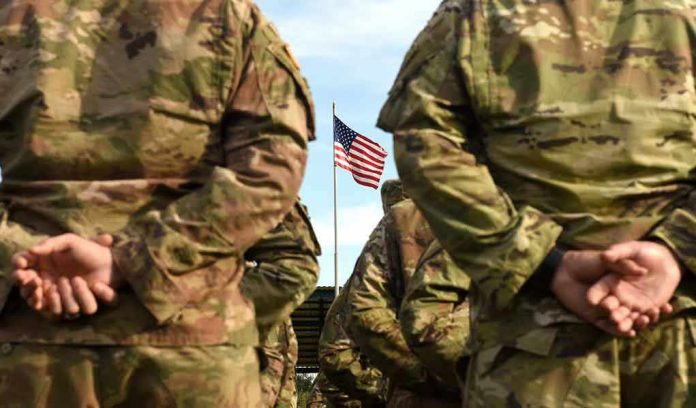
One small grenade tells a much bigger story: the Army is trying to rethink close-quarters combat without trusting shrapnel to do all the work.
Quick Take
- The Army cleared the M111 Offensive Hand Grenade for Full Material Release, calling it the first new lethal hand grenade to reach that milestone since 1968.[2]
- The M111 is built for enclosed spaces, where blast overpressure can work better than fragments.[2][3]
- The old Mk3A2 had an asbestos body, and the new grenade uses a plastic body that is fully consumed during detonation.[2][1]
- The Army says the M111 will supplement, not replace, the M67 fragmentation grenade.[2][3]
A New Weapon Built for Tight Spaces
The Army says the M111 exists for a simple reason: rooms, bunkers, caves, and tunnels change the fight.[2][10] In those spaces, fragments can bounce, miss, or endanger friendly troops. The M111 uses blast overpressure, a shock wave from the blast, to hit enemy personnel and equipment without relying on metal fragments.[2][1] That design gives commanders a tool built for closed terrain, not open fields.
The official Army release says the weapon was developed by the Capabilities Program Executive Ammunition and Energetics with the U.S. Army Combat Capabilities Development Command Armaments Center at Picatinny Arsenal.[2] The Army also says the M111 improves training and operational readiness because soldiers can use a grenade with a safer body design and a familiar arming process.[2] That matters more than it sounds. A weapon that is easier to train on and less hazardous to handle tends to get used more confidently.
Why the Old Grenade Was No Longer Enough
The Mk3A2 served for decades, but the Army says it became restricted because of its asbestos body.[2][9] That is the kind of legacy problem that never looks urgent until someone tries to keep a fleet, a warehouse, or a training cycle going around it. The M111’s plastic body is fully consumed during detonation, which removes the old asbestos issue and helps modernize the design.[2][1] The Army is not just replacing a grenade. It is replacing an old set of compromises.
The important nuance is that the M111 is not a magic answer for every fight. The Army says the M67 fragmentation grenade still has a role in open terrain, where fragments can spread farther and do their job.[2][3] The M111 is the specialist, not the generalist. That pairing makes sense in plain English. Use the fragment grenade where distance helps. Use the blast grenade where walls and furniture would ruin the effect.
The Real Debate Is About Proof, Not Hype
Supporters point to a clear tactical logic: blast overpressure is less likely to be defeated by interior barriers than fragmentation.[2][3] Critics point to a different issue. The public record shows Army claims, reporting, and commentary, but not independent, peer-reviewed field data proving the M111 is decisively better in real combat conditions. That gap matters. A weapon can sound ideal on paper and still prove ordinary under stress.
The best case for the M111 is not that it makes war cleaner. It does not. The best case is narrower and more practical: it gives soldiers another way to fight in places where the old grenade fit badly.[2][8] That is a conservative kind of military improvement, focused on fit, function, and readiness rather than novelty for its own sake. The real test now is whether the Army can move from approval to useful fielding without losing that edge.
Sources:
[1] Web – Army Fields First New Hand Grenade Since 1968
[2] Web – M111 Grenade Approved, Replacing Vietnam-Era Design
[3] Web – Army approves M111, first new lethal hand grenade since 1968
[8] Web – The Army has approved the M111 Offensive Hand Grenade …
[9] Web – Grenades, M67 Hand Fragmentation & M111 Hand Offensive and …
[10] Web – U.S. Army Testing First New Hand Grenade in Nearly 60 Years