Protesters demanding “abolish the police” were escorted and protected by police anyway—while nationwide unrest over war, immigration enforcement, and executive power keeps boiling.
Quick Take
- “No Kings” protests on March 28, 2026, spread across the country, with major flashpoints in Los Angeles, Denver, and Dallas.
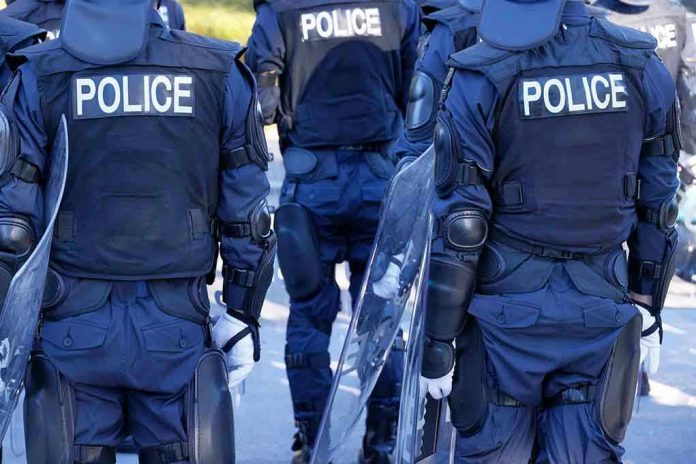
- Video circulating from the demonstrations shows anti-police chanting alongside visible reliance on law enforcement protection.
- Los Angeles officials reported objects thrown at a DHS facility, prompting tear gas after warnings and a dispersal order followed by arrests.
- Organizers promoted 3,200+ events globally and framed the day as non-violent, even as some locations saw clashes and arrests.
What Happened on March 28: Protests, Dispersal Orders, and Arrests
Demonstrations branded as “No Kings” unfolded nationwide on March 28, with Los Angeles becoming a central point of confrontation near federal facilities. Los Angeles police placed the city on a tactical alert, and federal authorities deployed tear gas after protesters allegedly threw objects at a Department of Homeland Security site. A dispersal order was issued around 5:30 p.m. local time with a brief window to leave before arrests began.
Reports from other cities showed similar tensions without identical intensity. Denver police made nine arrests during clashes tied to a road-blocking protest action, while Dallas saw at least one arrest amid demonstrations and counter-demonstrations. Across locations, authorities described crowd-control decisions as responses to escalating behavior, while organizers highlighted turnout numbers and broad opposition to Trump administration policies, including the ongoing war with Iran and ICE operations.
The “Abolish the Police” Irony—and What the Video Actually Proves
The viral moment driving conservative attention came from footage showing protesters chanting “abolish the police” while being escorted and protected by police officers. The image is politically potent because it captures a core contradiction: activists demanding the removal of public order institutions while benefiting from those same institutions when crowds surge and tensions rise. The footage is strong evidence of the moment itself, but it does not, by itself, establish the beliefs or actions of every attendee.
The bigger point for readers is what the scene reveals about reality during mass unrest. When events spill into confrontations near federal buildings, most Americans still expect law enforcement to separate groups, keep routes open, and prevent violence. That expectation is not partisan—it is basic public safety. Conservatives who watched “defund” politics drive recruitment problems and morale drops in prior years see these clips as confirmation that ideological slogans collapse fast when conditions become dangerous.
Who’s Organizing the Protests—and Why the Funding Questions Matter
Multiple reports described a large, decentralized organizing ecosystem powering the protests, with Indivisible identified as a lead coordinator alongside groups like 50501, Third Act Movement, and the AFL-CIO. Coverage also pointed to a broader network of hundreds of aligned organizations with significant combined revenues, and to claims that radical factions seek revolutionary outcomes. Those claims vary in documentation by outlet, but the scale of coordination and resources is not in dispute.
For a constitutional-minded audience, the central question is not whether Americans can protest—they can, and should, peacefully. The question is whether large, professionally organized protest networks encourage tactics that cross into intimidation, disruption of public services, or clashes that invite emergency responses. When protests end with tear gas, arrests, and tactical alerts, citizens are right to ask who set the tone, who trained marshals, and whether organizers publicly discouraged illegal behavior as strongly as they promoted turnout.
Where This Intersects With 2026’s Political Fault Lines: War, Borders, and Trust
These protests are not happening in a vacuum. The movement’s opposition includes the war with Iran and ICE operations, both of which have split the wider electorate and now strain parts of the pro-Trump coalition. Some MAGA voters who backed Trump expecting fewer foreign entanglements are frustrated that the U.S. is again absorbed in a high-cost conflict while energy prices remain a household pressure point. That frustration can coexist with support for border enforcement and public order.
Organizers and sympathetic coverage emphasized “record-breaking” participation and a largely non-violent intention, while on-the-ground reporting documented specific incidents, including thrown objects and arrests. With limited publicly confirmed detail about each confrontation, the safest conclusion is narrow: the protests were massive, uneven across cities, and occasionally volatile. Conservatives should watch for any policy response that expands federalized crowd-control authority in ways that erode First Amendment protections—or for local leaders who tolerate disorder that endangers families and small businesses.
Sources:
As No Kings protests grow, a bigger question looms: What comes next?
No Kings protests US Trump administration 03-28-2026
State, local police security third No Kings rally