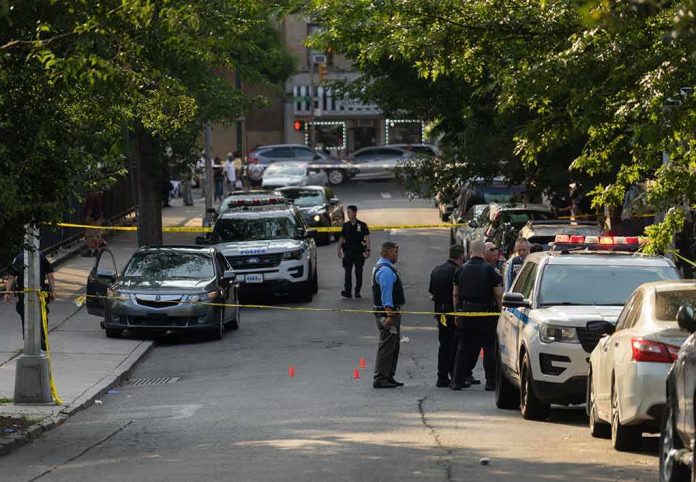
Police say a 12-year-old boy is charged with killing a 13-year-old on a D.C. sidewalk.
Story Snapshot
- Officers arrested a 12-year-old in Northeast D.C. and charged him with voluntary manslaughter while armed.
- The charge ties him to the July 11 shooting that killed 13-year-old Ahmad Mims on Rosedale Street NE.
- First responders found Mims around 8:24 p.m.; he was pronounced dead at the scene.
- A search-warrant affidavit described witness claims of a fight tied to the shooter’s sister.
A preteen arrest in a deadly July shooting
The Metropolitan Police Department reported the arrest of a 12-year-old boy from Northeast D.C. on August 19, 2026. Officers with the Capital Area Regional Fugitive Task Force took him into custody. Police charged him with voluntary manslaughter while armed in the killing of 13-year-old Ahmad Mims. Detectives linked the case to a July 11 shooting in the 1600 block of Rosedale Street Northeast. The victim’s age and the suspect’s age turn a neighborhood gunshot into a citywide shock.
Officers said they responded to Rosedale Street at about 8:24 p.m. after reports of gunfire. They found Mims on the sidewalk with a gunshot wound. D.C. Fire and Emergency Medical Services pronounced him dead at the scene. The location sits near Kingman Park homes, where evening foot traffic and families are common in summer. The tight timeline from call to pronouncement left detectives with a narrow window to trace movements and collect video.
What detectives say points to manslaughter
Police charged voluntary manslaughter while armed, not premeditated murder. That choice often tracks with a claim of sudden heat of passion. A search-warrant affidavit, as described in local reporting, said witnesses told detectives Mims was killed after he hit the suspected shooter’s sister. That alleged spark suggests a fast, angry response rather than planning. The legal frame matters. It shapes which facts prosecutors must prove and how a judge views the teen’s state of mind.
Investigators also looked at video to build a timeline. A local outlet reported that footage showed two teens waiting in a hallway before the killing around 8:30 p.m. That kind of clip can anchor the when and the who. It can place people in shared space, match clothing, and confirm movement in and out of a door or stairwell. Even without audio, timestamps and angles help knit together witness accounts and phone records.
How age, law, and accountability collide
Washington’s juvenile system centers on rehabilitation, but it must also protect the public. Courts handle children differently from adults because brain science and the Supreme Court say youth matters at sentencing. The Supreme Court’s Miller v. Alabama line bars mandatory life without parole for juveniles, even in homicide cases. Judges must weigh age, background, and the chance to grow past a terrible act. That is mercy with guardrails, not a free pass.
Data can steady the debate. The Criminal Justice Coordinating Council reported that D.C.’s total violent crime fell to a 30-year low in 2024. The share of violent-crime arrests involving juveniles fell to 29 percent. Those numbers do not erase the pain a single case brings. They do remind us that most violent crime still involves adults, and that policy should track trends, not just headlines.
What common sense expects next
Prosecutors now carry the burden. They must show the court why the voluntary manslaughter while armed charge fits the facts. The defense will likely stress the boy’s age and any provocation. The judge will demand clear evidence about who fired, why, and how the gun was present. The public should expect respect for victims and a fair process for the accused. Justice is not a social-media sprint. It is careful work, done under oath, with real stakes for a grieving family.
Sources:
washingtontimes.com, dcchroniclenews.com, abcnews4.com, instagram.com