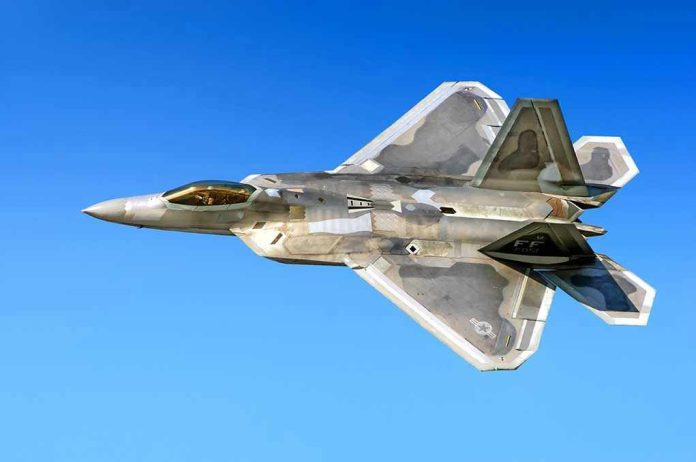
Fighter jets tearing across the Washington sky were not a movie scene but the visible tip of an air-defense system that snaps into action the moment one small airplane stops talking.
Story Snapshot
- A single confused or silent pilot can trigger armed fighters over the nation’s capital within minutes.
- Most of these scrambles end with “communications error,” not missiles or handcuffs.
- Temporary presidential no-fly zones turn normal airspace into a tripwire grid.
- The same rules that protect presidents also reveal how dangerously thin the margin is between routine and crisis.
How One Silent Aircraft Can Lock Down the Capital
Washington, D.C. sits under some of the most tightly controlled airspace on the planet. When radar shows a civilian aircraft wandering where it should not be and the pilot is not responding, the North American Aerospace Defense Command, known as NORAD, does not wait for lawyers or headlines. Controllers pick up the phone, and fighters launch. NORAD described one such event bluntly: two F-15 fighters scrambled at 1:15 p.m., under its control, to check out a civilian aircraft suggesting a hijacking.[3]
The timing illustrates how little slack exists. That same NORAD report notes that the fighters were on the scene quickly and stayed with the target until it landed safely at Miami International Airport just thirty minutes later.[3] No dramatic dogfight, no smoking crater, just a very fast escort to a very normal runway. Yet those thirty minutes represent the entire window in which commanders must decide whether an airliner full of travelers is actually a weapon pointed at a city.
Temporary Flight Restrictions: Invisible Fences With Teeth
When a president travels, the Federal Aviation Administration quietly draws a circle in the sky called a Temporary Flight Restriction, or TFR. That circle becomes an invisible fence, and any unauthorized aircraft that drifts across it instantly becomes a problem for NORAD. During one weekend near former President Trump’s Mar-a-Lago resort, jets scrambled after a small civilian plane breached this restricted airspace, and pilots even fired flares to get the errant pilot’s attention.[1] The TFR turns bad navigating into a national security question.
These restrictions do not exist only in Florida golf country. NORAD has detailed how two F-16 fighters from Andrews Air Force Base intercepted a Beech King Air that violated the Air Defense Identification Zone over Washington, D.C., escorting it out of restricted airspace to a small Virginia airport. That interception looked routine on paper, but the decision chain behind it reflects the post‑September 11th mindset: when in doubt, launch first, ask questions later. Many Americans driving the Beltway beneath that flight had no idea that armed jets had just made sure a wandering twin‑engine turboprop was nothing more than a navigation mistake.
From “Hijacked” Alert to Harmless Error in Minutes
The most revealing part of NORAD’s own account is not the scramble; it is the anticlimax. NORAD explains that the fighters launched because the civilian aircraft was “indicating that it was high-jacked.” Then, just as quickly, air traffic control in Miami reestablished contact and “quickly determined that it was a communications error.”[3] That single sentence shows why these incidents confuse the public. The system must treat an ambiguous blip like a hijacking, even though most turn out to be a pilot who pushed the wrong code or missed a radio call.
For anyone who values limited government but demands basic national defense, this is a hard balance. On one hand, scrambling fighters for every radio glitch sounds excessive. On the other hand, when an airplane wanders into protected airspace silent and off course, common sense says someone in uniform had better go look fast. The fact that these interceptions typically end with safe landings and paperwork rather than arrests actually suggests a defense posture that errs on the side of caution without automatically criminalizing pilots who make honest mistakes.[3]
Media Spectacle, Real Stakes, and What We Are Not Being Told
Television prefers the most dramatic visuals: fighters roaring overhead, flares streaking down, maps with big red circles around Trump properties or the Capitol dome.[1] The grinding detail behind those images—radar handoffs, emergency transponder codes, terse phone calls between the Federal Aviation Administration and NORAD—rarely makes the cut. Yet those details matter. NORAD’s short public statements usually confirm the scramble, the escort, and the safe landing, then refer reporters to the Federal Aviation Administration for everything else.[3] That leaves plenty of room for pundits to fill the silence with speculation.
More transparency would serve both security and liberty. Declassified timelines, audio, and after‑action summaries would let citizens see whether officials reacted proportionally or overreached. When NORAD reports that a King Air violated the Washington Air Defense Identification Zone and was escorted to a quiet Virginia airfield, the public learns only that the system worked well enough that nothing exploded. We do not see whether confusing rules, late notices, or airspace design helped create the problem in the first place. A government serious about both safety and accountability would not hide those lessons behind jargon and brevity.
Sources:
[1] Web – Fighter jets scrambled, flares deployed after plane spotted near …
[3] Web – NORAD fighters scrambled today