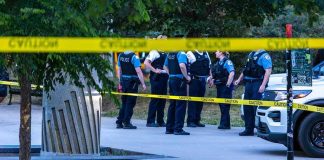
Forty pounds of fentanyl moved through a public park like it was a storefront—until 300 officers showed up at once to shut the whole thing down.
Quick Take
- Federal and local agencies launched “Operation Free MacArthur Park” on May 6, 2026, targeting a long-running open-air drug market in central Los Angeles.
- Authorities arrested 18 people, filed a federal complaint naming 25 defendants total, and continued searching for seven suspects still at large.
- Investigators seized roughly 40 pounds (about 19 kilograms) of fentanyl valued at more than $10 million, alongside a methamphetamine-focused supply chain.
- Prosecutors tied key suppliers to the 18th Street Gang and emphasized the operation was not related to immigration enforcement.
A Park, a Pipeline, and a Raid Built Like a Military Operation
MacArthur Park sits in dense, transit-linked Los Angeles real estate, the kind of location where foot traffic never stops and exits come in every direction. That geography helps families, commuters, and vendors—and it also helps dealers. On May 6, 2026, more than 300 personnel, including over 200 from the DEA and about 100 from LAPD, executed a coordinated sweep meant to break an open-air market that authorities said had been “running rampant.”
Nine search warrants hit in a synchronized burst: six in or around MacArthur Park and three more stretching to Calabasas, San Gabriel, and South Los Angeles. This matters because it signals intent. Street dealing is the visible symptom; supply is the disease. A warrant strategy that leaps from a park bench to suburban stash locations aims at the business structure behind the chaos, not just the chaos itself.
What Investigators Say They Built: 27 Deals, Then a Federal Complaint
Authorities said the investigation ran from March 9 through April 15, documenting 27 separate drug deals before the May 6 takedown. That timeline reads like classic case-building: observe, record, identify repeat players, then strike when search warrants can do the most damage. The federal complaint named 25 defendants. Eighteen landed in custody quickly, while seven remained wanted as of May 8, keeping pressure on the network’s remaining links.
The fentanyl number grabbed headlines for a reason: about 40 pounds, valued at over $10 million, with officials describing lethal-dose potential in the hundreds of thousands. Whether every gram would have reached the street exactly as packaged is unknowable, but the scale tells the story. This was not a handful of pills; it was bulk product. Conservative common sense says you do not treat bulk poison distribution as a “quality-of-life” issue—you treat it as organized crime.
The Suppliers Named, the Gang Connection Highlighted, and Why Calabasas Shows Up
Federal authorities identified alleged supply roles that spanned from street-level dealing to higher-level distribution. Mallaly Moreno-Lopez, 31, and Jackson Tarfur, 28, both from Westmont in South Los Angeles, were described as primary suppliers of fentanyl powder and methamphetamine operating on behalf of the 18th Street Gang. Yolanda Iriarte-Avila, 40, in Calabasas, was characterized as a top trafficker tied to meth distribution, and Jesus Morales-Landel, 33, was described as a park-area dealer.
Calabasas confuses people because it clashes with the mental picture of an “open-air drug market.” That mismatch is the point. Sophisticated trafficking uses distance and optics as camouflage: stash product where fewer people expect it, then drip-feed it into high-demand zones. If authorities seized a large portion of fentanyl at a single residence, it suggests a hub-and-spoke model—bulk stored away from the park, then routed to sellers who keep the storefront stocked.
“Reclaiming” the Park: Public Safety Message vs. Reality on the Ground
First Assistant U.S. Attorney Bill Essayli framed the operation as the start of “reclaiming MacArthur Park” and returning it to the citizens of Los Angeles. He also emphasized it was not an immigration operation, a clarification that reveals how fraught public trust has become. The message tries to draw a bright line: target traffickers, not neighborhoods. That distinction matters in a city where enforcement can spark backlash even when the problem is obvious.
Order matters to communities, and parks are supposed to be the most basic civic promise: a shared place where families can exist without negotiating with criminals. When an open-air drug market dominates a public space, it taxes everyone—residents, small businesses, and the law-abiding homeless alike. Enforcement alone cannot fix addiction, but law enforcement can and should stop predatory distribution. A government that cannot protect a park cannot credibly claim it can protect anything else.
What Comes Next: Displacement, Retaliation Risk, and the “Only the Beginning” Claim
Authorities called the operation “only the beginning,” and the seven wanted suspects underline that unfinished business. The near-term question is displacement: markets pushed out of a visible hotspot often reappear on adjacent blocks or move online. The longer-term question is whether dismantling this chain sparks competition and violence as other crews attempt to capture territory and customers. The 18th Street Gang connection suggests the operation hit revenue, and lost revenue can trigger reorganization.
Success will not be measured by the photo-op of evidence bags; it will be measured by whether MacArthur Park stays usable a month from now, and whether prosecutions climb the chain instead of stopping at the bottom. Conservatives tend to distrust feel-good slogans, and rightly so. The facts that matter are plain: coordinated warrants, bulk fentanyl seized, named suppliers, and ongoing fugitives. If follow-through fades, the park becomes a lesson in temporary crackdowns. If follow-through sticks, it becomes a template.
Los Angeles has tried piecemeal fixes for years, and MacArthur Park kept broadcasting the same warning: when the state tolerates open criminal markets, predators move in fast and ordinary people move out. “Operation Free MacArthur Park” tested a harder approach—hit suppliers, hit stash points, hit the network all at once. The open loop now sits with the courts and with city leadership: keep pressure on the pipeline, or watch the next one rebuild in the same public space.
Sources:
feds-seize-mountain-fentanyl-open-air-drug-market-massive-crackdown-targeting-gang-crews
feds-conduct-raid-macarthur-park
macarthur-park-drug-raid-uncovers-40-pounds-of-fentanyl-seized-18-arrested