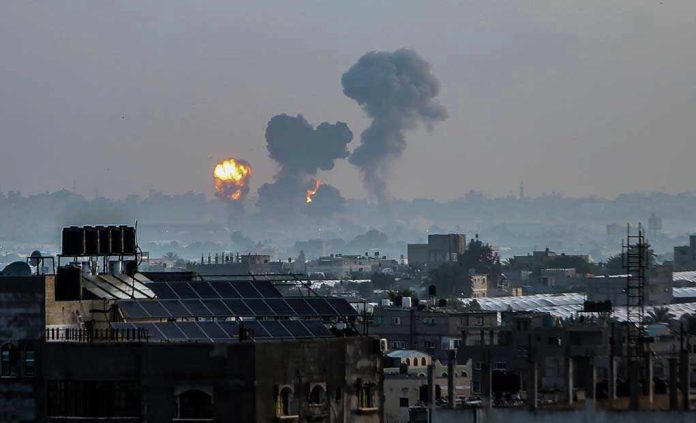
Israel delivered crippling strikes to Iran’s petrochemical infrastructure and killed senior IRGC commanders as Trump’s deadline to reopen the Strait of Hormuz looms, dealing what officials call a devastating economic and military blow worth tens of billions of dollars.
Story Highlights
- Israeli airstrikes targeted South Pars and Mahshahr petrochemical complexes, halting 85% of Iran’s petrochemical exports and dismantling critical facilities supplying materials for weapons production
- Two senior IRGC officers killed in Tehran strikes as Israel escalates operations beyond infrastructure to eliminate military leadership
- Attacks align with Trump’s ultimatum for Iran to reopen the Strait of Hormuz, intensifying economic pressure as ceasefire talks falter
- Israel previously destroyed 70% of Iran’s steel production capacity, systematically dismantling Iran’s ability to manufacture missiles, drones, and explosives
Coordinated Strikes Cripple Iran’s Industrial Backbone
Israeli Defense Forces executed coordinated airstrikes on Iran’s South Pars petrochemical complex in Assaluyeh and the Mahshahr Petrochemical Special Zone between April 4 and April 6, 2026. The South Pars facility represents Iran’s share of the world’s largest offshore natural gas field and accounts for approximately 50% of the nation’s petrochemical production. Defense Minister Israel Katz confirmed the strikes eliminated facilities responsible for 85% of Iran’s petrochemical exports, describing the operation as a “powerful strike” targeting infrastructure critical to both Iran’s economy and weapons manufacturing capabilities. The attacks also hit the Marvdasht complex, cutting utilities including electricity, water, and oxygen supplies to production sites.
Strategic Timing Amplifies Trump Administration Pressure
The Israeli operations coincide with President Trump’s deadline for Iran to reopen the Strait of Hormuz, a critical shipping lane Iran has effectively closed through military actions. Trump previously threatened to devastate Iranian infrastructure if the waterway remains blocked, creating a strategic alignment between U.S. economic pressure and Israeli military action. This coordination underscores the Trump administration’s willingness to support aggressive measures against Iranian assets that fund the Islamic Revolutionary Guard Corps and enable regional destabilization. Iran has defied the deadline despite the mounting economic costs, setting the stage for potential further escalation that could reshape Middle Eastern energy markets and global supply chains.
IRGC Leadership Eliminated in Expanding Campaign
Israeli forces killed two senior IRGC officers in Tehran during overnight strikes on April 5-6, marking an escalation from infrastructure targets to military leadership elimination. The strikes also targeted airports used by IRGC operations, demonstrating Israel’s expanded targeting parameters during the ongoing conflict. This approach mirrors Israel’s earlier destruction of 70% of Iran’s steel production capacity, which directly undermined Iran’s ability to manufacture ballistic missiles, drones, and naval vessels. The systematic dismantling of both industrial capacity and command structure represents a comprehensive strategy to degrade Iran’s military-industrial complex. Israeli officials declared “no immunity” for Iranian targets even as ceasefire mediators attempted to negotiate a pause in hostilities.
Economic Devastation Threatens Regime Stability
The petrochemical strikes inflict immediate production halts at facilities generating revenue streams worth tens of billions of dollars annually. South Pars petrochemicals supply materials for explosives, ballistic missiles, and drones, making these sites dual-use targets with both economic and military significance. The Saturday strikes on Mahshahr killed five workers and shut down utility plants supplying over 50 downstream facilities, effectively paralyzing an entire industrial zone. Iranian state media downplayed damage while confirming fires were contained, contrasting sharply with Israeli claims that facilities were “taken out of operation.” The long-term implications threaten Iran’s ability to fund IRGC operations and maintain its military capabilities across the region, potentially forcing difficult choices between domestic needs and proxy warfare.
Regional Stakes and Escalation Risks
Iran previously retaliated against March strikes on South Pars by attacking Gulf energy infrastructure, including Qatar’s Ras Laffan facility and Israel’s Haifa refinery, demonstrating Tehran’s willingness to expand conflict beyond bilateral exchanges. Gulf states face vulnerability to Iranian counterattacks as Israel systematically degrades Iran’s economic foundations, raising concerns about broader regional instability affecting global energy supplies. The disruption to the world’s largest gas field carries implications for international petrochemical markets and energy prices. Despite ongoing ceasefire mediation efforts, the tempo of Israeli operations suggests Prime Minister Netanyahu’s government prioritizes permanent degradation of Iranian capabilities over diplomatic pause. This calculus aligns with conservative principles favoring decisive action against threats rather than negotiations that preserve adversary capabilities, though it raises questions about whether Washington’s deep state interests in perpetual conflict are being served alongside legitimate security concerns.
Sources:
WRAL: Airstrikes on Iran kill more than 25 as Trump’s deadline to open Strait of Hormuz looms
Channel News Asia: Israel strikes South Pars petrochemical plant in Iran war
i24News: Israel strikes Iran’s Mahshahr petrochemical complex, halting production