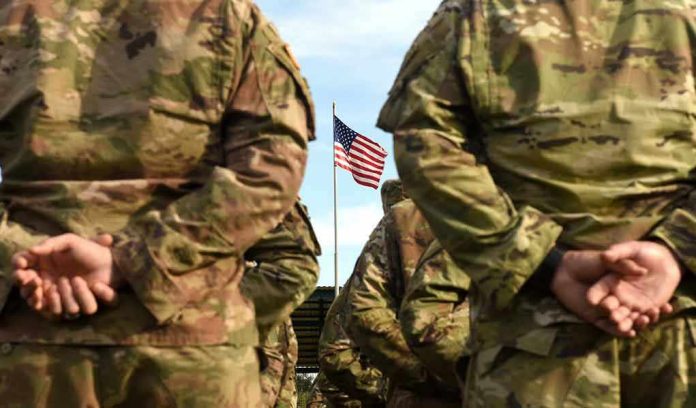
President Trump’s military is expanding control over nearly 200 additional miles of Texas border through National Defense Areas, transforming civilian land into federal military zones where troops can now patrol, detain trespassers, and prosecute illegal border crossers with federal charges.
Story Snapshot
- Air Force extends military jurisdiction over 190 miles of Rio Grande riverbank, bringing Texas NDAs to 440 total miles under direct military supervision
- Approximately 8,500 active-duty troops now patrol designated zones with authority to detain trespassers and charge illegal entrants with federal misdemeanors carrying up to 18 months prison time
- Over 1,400 immigrants already charged with NDA trespassing violations since program inception in April 2025
- Border crossings plummeted from 2.1 million in 2024 to 444,000 in 2025, yet military presence continues expanding amid questions about necessity
Trump Administration Expands Military Border Control
The US Air Force announced expansion of National Defense Area 3 by 40 miles upriver to Roma, Texas, and established a new 150-mile NDA 6 stretching from Falcon Dam to Del Rio. Air Force Secretary Troy Meink confirmed the designations strengthen interagency coordination while authorizing troops to temporarily detain trespassers on what is now classified as Defense Department property. These zones transform civilian borderland into de facto military installations, enabling active-duty forces to circumvent Posse Comitatus Act restrictions that typically prevent military involvement in domestic law enforcement operations.
The expanded control brings total Texas NDA coverage to approximately 440 miles of Rio Grande riverbank under Joint Base San Antonio supervision. Defense Secretary Pete Hegseth directed the January 2025 surge of 1,500 additional troops plus air and intelligence assets to achieve what he terms “100% operational control” of the southern border. Joint Task Force Southern Border now deploys UH-72 helicopters, C-130 and C-17 transport aircraft, Stryker armored vehicles, Seasats Lightfish autonomous monitoring vessels, and destroyer Cole to support Customs and Border Protection operations across designated zones.
Legal Framework Enables Direct Military Detention Authority
National Defense Areas originated from Trump administration border policies following his 2025 inauguration, building on 2019-2021 deployments. The designations classify borderland as military installations, first pioneered in New Mexico with 170 miles in April 2025, followed by western Texas zones in May. This legal framework authorizes military personnel to conduct patrols, execute detentions, and pursue federal trespass prosecutions without violating Posse Comitatus restrictions. Unlike Texas Governor Greg Abbott’s Operation Lone Star that relies on state National Guard forces, NDAs deploy federal active-duty troops with expanded detention powers previously unavailable to military personnel on domestic soil.
More than 1,400 immigrants have faced federal misdemeanor charges for NDA incursions since program implementation, with penalties reaching up to 18 months imprisonment. Military forces conducted at least three direct detentions in New Mexico, with court outcomes showing mixed results on prosecutions. The ACLU raised concerns about border communities losing access to public lands for hiking and hunting, while poorly marked zones create risks of trespass prosecutions for US citizens. This represents a fundamental shift in immigration enforcement, adding federal trespass charges to existing immigration violations and restricting humanitarian group access to borderland areas.
Record-Low Crossings Spark Militarization Debate
Customs and Border Protection data confirms border crossings dropped dramatically from 2.1 million in 2024 to 444,000 in 2025, representing an 79-percent decline. Despite these record-low numbers, the Trump administration continues expanding military presence along one-third of the US-Mexico border. Jennifer Kavanagh from Defense Priorities criticized the expansion as unnecessary militarization given plummeting immigration statistics. Defense experts question the rationale for surging military assets when border crossings have collapsed to levels not seen in decades, suggesting policy momentum rather than operational necessity drives continued deployments.
Defense Secretary Hegseth frames the mission as approaching accomplishment, citing Mexico’s agreement to deploy 10,000 troops on its side of the border as evidence of international cooperation. The approximately 8,500 JTF-SB troops prioritize supporting CBP leadership while installing barriers and signage throughout designated zones. However, troop deployments strain Department of Defense resources and recruitment capabilities, while isolating border communities and heightening concerns among residents about federal overreach. For Americans who endured the Biden administration’s open-border policies that created unprecedented illegal immigration and cartel activity, this military presence represents the decisive action needed to restore sovereignty and protect communities left vulnerable by years of neglect.
Sources:
The US military is taking formal control of more Texas borderland – Defense One
Texas military zone expansion raises concerns about illegal immigration enforcement – Texas Tribune
Military zones expanding at border – Stars and Stripes
National Defense Areas expanded, established along Texas border – US Air Force
Defense Secretary says full control of southern border equals mission accomplishment – US Army
Operation Lone Star – Office of the Texas Governor