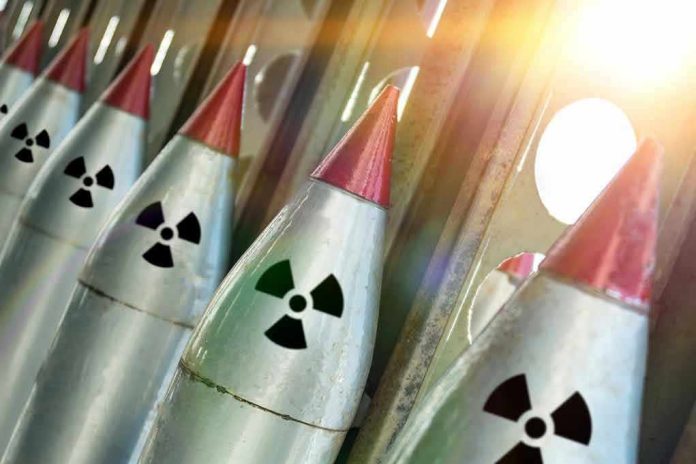
The world is quietly rebuilding the machinery of nuclear brinkmanship faster than the institutions meant to stop it can keep up.
Story Snapshot
- Great powers are modernizing nuclear arsenals while the global arms‑control system frays.
- North Korea’s sprint toward hypersonics, submarines, and mass munitions production exposes systemic failure.
- Nuclear norms built over 50 years are eroding just as technology shrinks warning time and increases ambiguity.
- 2026 marks a critical test of whether the nuclear order bends or breaks under geopolitical and technological strain.
Why Nuclear Risk Is Back At The Center Of Global Politics
The post–Cold War dream that nuclear danger would slowly fade has collided with a harsher reality: major powers are treating nuclear capability as the last, unchallengeable currency of power again. The United States, Russia, and China are all modernizing or expanding arsenals, while key treaties that once put a ceiling on risk have collapsed or stalled.[5] The Cuban Missile Crisis is no longer a history‑channel relic; it is a template for a future crisis that could unfold faster and with more players.
Review conferences for the Non‑Proliferation Treaty in 2015 and 2020 failed to produce consensus, and the 2025 preparatory session for the 2026 review broke down as well. Non‑nuclear states increasingly question why they should remain bound by a system that permits modernization and expansion at the top while lecturing restraint below. That legitimacy erosion matters because the NPT’s authority rests not on force, but on shared belief that its rules are fair, credible, and enforced, especially when nuclear powers accuse others of violations.
North Korea As A Case Study In Systemic Breakdown
North Korea illustrates how a determined state can exploit a weakening order. Kim Jong Un has embedded nuclear weapons into the regime’s identity, arguing that U.S. interventions abroad prove nuclear arms are the only reliable shield. Pyongyang has moved beyond crude bombs to a diversified arsenal: long‑range ICBMs, solid‑fuel and maneuverable missiles, and now hypersonic systems designed to compress reaction times and challenge defenses. Each upgrade forces the United States and its allies to reconsider crisis plans and threshold calculations.
In late 2025, Kim ordered a significant surge in missile and munitions production for 2026, expansion of existing plants, and construction of new ammunition factories, explicitly tying this industrial push to strengthening “military deterrence.” Satellite imagery and state media point to parallel work on a nuclear‑powered “strategic nuclear attack submarine,” bringing sea‑based deterrent capabilities into play. These moves do more than threaten Seoul or Tokyo; they stress test the entire sanctions regime and highlight how enforcement weakens when a nuclear‑armed state is backed by a permanent UN Security Council member.
Russia–North Korea Cooperation And The Arms‑Control Vacuum
Russia’s deepening reliance on North Korean munitions for its war against Ukraine has created a troubling two‑way street: shells and missiles flowing to Russia, political cover and potential technology flowing back to Pyongyang. A monitoring group of U.S., Japanese, South Korean, and other officials has labeled this cooperation “illegal,” arguing it violates UN sanctions and strengthens North Korea’s ballistic missile program. When a veto‑wielding power shrugs at the rules it once helped write, the deterrent effect of international law erodes for everyone.
Moscow’s nuclear rhetoric around Ukraine—thinly veiled threats to deter NATO involvement—normalizes nuclear coercion in a way conservatives rightly find reckless. Deterrence should rest on restrained, credible capability, not theatrical threats that invite miscalculation. When Russia mixes conventional setbacks with nuclear saber‑rattling, it signals to smaller states that nuclear weapons are tools for political blackmail, not last‑resort insurance. That lesson undercuts decades of American efforts to tie nuclear status to responsibility, transparency, and strategic stability rather than opportunistic intimidation.
Technology, Compressed Decision Time, And Conservative Common Sense
Hypersonic missiles, dual‑use delivery systems, and cyber‑vulnerable command networks create a risk environment where leaders may have minutes—not hours—to decide if a radar track is real and whether to respond. North Korea’s January 2026 hypersonic drill, framed as testing “war deterrent” and offensive capabilities, fits this pattern. When an adversary can launch a weapon that might be nuclear or conventional, and might evade defenses, the pressure to assume the worst and shoot first grows, especially in a crisis.
American conservative values favor prudence, verifiable strength, and limited, clearly defined commitments over utopian disarmament slogans. That perspective aligns with several common‑sense steps: keeping U.S. deterrent forces modern and survivable; demanding rigorous, enforceable verification in any arms‑control deal; and resisting cosmetic agreements that let adversaries cheat while Washington disarms unilaterally. At the same time, conservative realism should recognize that hotlines, crisis‑management rules, and narrowly tailored treaties serve U.S. interests by lowering odds of accidental or mistaken nuclear use.
2026 As A Critical Decision Point For The Nuclear Order
Analysts describe 2026 as a “critical moment” for preserving the global nuclear order, not because of one dramatic summit, but because the trend lines all bend in the wrong direction at once. With the NPT review process in crisis, North Korea accelerating its program, and great‑power tensions hardening, the risk is less a single Armageddon scenario than a creeping normalization of nuclear brinkmanship. The longer that normalization persists, the more likely miscalculation, technical failure, or domestic political panic yields catastrophe.
Common sense suggests a dual track: sustain and modernize U.S. and allied deterrence while pressing for narrow, enforceable risk‑reduction steps—on launch‑on‑warning postures, hypersonic deployments, and dangerous nuclear rhetoric. Citizens over 40 remember duck‑and‑cover drills and the Cold War’s end; they have seen how quickly elites forget hard‑earned lessons. The real question is whether today’s leaders treat nuclear order as a disposable relic, or as a fragile guardrail that must be repaired before the road ahead curves out of sight.
Sources:
North Korea 2026: Will US and South Korea push talks – and succeed?
Kim Jong-un expected to cling to nuclear ‘security blanket’
Kim Jong Un orders North Korea to boost missile production in 2026
2026 Signals Critical Moment to Preserve Nuclear Order
North Korea says latest tests involve hypersonic weapons system
North Korea’s Nuclear and Ballistic Missile Programs (CRS)
North Korea Conducts First Missile Launch of 2026 Into Sea of Japan
NK News report on North Korea’s early 2026 missile activities