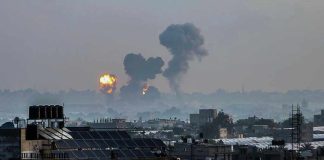
A single downed F-15 over Iran just yanked America closer to another Middle East escalation—exactly the kind of “forever war” trap millions of Trump voters thought they were done funding.
Quick Take
- U.S. special operations forces rescued a missing F-15E crew member inside Iran after nearly 48 hours on the run in mountainous terrain.
- The mission reportedly used hundreds of commandos, multiple helicopters, MQ-9 Reaper drones, and fixed-wing support aircraft, with some U.S. equipment destroyed on the ground to avoid capture.
- President Trump publicly celebrated the operation as a success, but the scale and risk raise new questions about how close this standoff is to a wider war.
- Exact aircraft totals and damage claims remain unclear, and Iranian confirmations are limited or unverified in the available reporting.
Rescue Success, Strategic Warning
U.S. forces recovered a missing weapons systems officer after an F-15E Strike Eagle was shot down over southwestern Iran, according to detailed reporting on the operation. The airman reportedly evaded capture for nearly two days while U.S. aircraft and special operations teams searched hostile terrain under heavy time pressure. Officials framed the recovery as high-risk and complex, and the White House treated it as a major win. The rescue itself is real news—but it is also a flashing warning sign.
Early accounts indicate the first phase began immediately after the shootdown, when the pilot was extracted in a combat search-and-rescue effort. Reports also describe a separate incident near the Strait of Hormuz in which an A-10 was damaged, the pilot ejected, and the service member was later recovered in Kuwait. Search aircraft and helicopters operated over Iranian territory, and at least two Black Hawks reportedly took small-arms fire during the operation, underscoring how quickly a “recovery” can resemble open combat.
What the Operation Reportedly Required
Military reporting describes a rescue package that went far beyond a single helicopter pickup: MQ-9 Reapers provided surveillance and reportedly engaged Iranian ground groups; multiple helicopters moved personnel; and fixed-wing aircraft, including C-130s, supported the effort. U.S. teams reportedly set up a forward arming and refueling point inside Iran to keep aircraft moving, a sign of both urgency and logistical complexity. Some U.S. aircraft or equipment were reportedly destroyed on the ground after failures to prevent sensitive technology from being captured.
The key factual takeaway is not just that a service member came home, but that the U.S. conducted a deep, sustained operation in politically explosive airspace. That kind of footprint changes the strategic math. Even if Washington aims to avoid escalation, Tehran can claim sovereignty was violated and justify retaliation through proxies or direct responses. The available reporting does not provide verified Iranian confirmation of U.S. losses beyond what U.S.-side sources describe, leaving a fog of war that can be exploited by propaganda.
Why MAGA Voters Are Splitting on “What Comes Next”
The rescue lands at a moment when Trump’s coalition is more divided on foreign intervention than Republican politics has seen in decades. Many voters who endured years of inflation, energy price pain, and domestic chaos do not want another blank-check conflict, no matter how brave the troops are. At the same time, conservatives also expect the Commander-in-Chief to protect Americans and deter adversaries. Those two instincts collide when deterrence starts requiring repeated high-risk incursions that can spiral into sustained war.
The Real National Security Question: Escalation Control
Reports tie the rescue to broader U.S.-Iran tensions rooted in decades of hostility, with recent confrontations and attacks in the region raising the stakes. In that environment, each additional shootdown, drone strike, or rescue mission can create pressure for reprisals, sanctions, or military expansion—often faster than voters hear the full story. The public has limited confirmed detail on exact aircraft numbers, casualty counts, and what Tehran may do next. That uncertainty is precisely why Congress and the public will demand clarity on objectives, limits, and endgame.
For constitutional conservatives, the core issue is not whether rescuing an American is justified—it is whether the U.S. slides from discrete missions into undeclared, open-ended warfare without a clear authorization, measurable goals, or a defined exit. The administration can celebrate operational excellence while still confronting a hard truth: “daring” rescues are sometimes the opening chapter of a bigger conflict, not the ending. If Washington wants public support, it will have to show how it prevents this from turning into another generational commitment abroad.