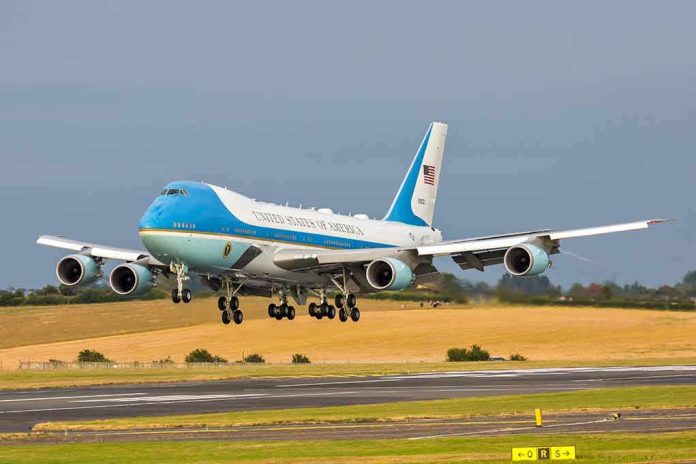
Four reporters asked how secure President Trump’s Qatari Air Force One really is—and ended up staring down federal subpoenas instead of simple answers.
Story Snapshot
- A $400 million Qatari luxury jet is now the president’s interim Air Force One.
- Experts say it lacks key defenses the older Air Force One still has.
- Trump and the Air Force insist the new plane is “safe” and “state-of-the-art.”
- Four New York Times reporters were subpoenaed after probing the jet’s security.
The luxury gift that became a flying security question mark
Qatar’s ruling family used this Boeing 747-8 for their own travel before talks began to hand it over for President Trump’s use as Air Force One. The jet is worth about $400 million, far beyond normal federal gift limits, so lawyers framed it as a gift to the United States government, not to Trump personally, to avoid emoluments problems. Trump wanted it fast, frustrated by long delays in Boeing’s official Air Force One replacement program.
The Air Force accepted the aircraft and began converting it into the so-called VC-25B Bridge, a stopgap presidential jet until the permanent replacements arrive later this decade. Officials promised secure communications and other classified upgrades to meet “presidential mission” needs. At the same time, a former U.S. official warned that, even after modifications, the Qatari jet would have “more limited capabilities” than the current VC-25A aircraft built from the ground up as Air Force One.
What the old Air Force One can survive that the Qatari jet may not
The existing VC-25A planes are flying bunkers. They are hardened against nuclear blasts, have advanced antimissile defenses, and can refuel in midair to keep the president aloft during a major crisis. Public documentation and expert commentary say the VC-25B Bridge lacks certain security features that the VC-25A fleet has, including advanced antimissile capabilities and air-to-air refueling. Those missing systems matter most in exactly the kind of high-threat environment Trump often talks about.
Former Air Force Secretary Frank Kendall explained that a president can choose a “luxury flying palace” and waive some security features, and nobody can force him to include them. That may be what happened here. Retired Marine Colonel Mark Kenshin and other analysts point to gaps like infrared missile countermeasures, robust electronic warfare tools, and full electromagnetic pulse hardening on the Qatari jet. Critics argue these are not “nice to have” extras; they are basic survival tools when hostile nations target the president.
Official assurance versus expert doubt
The Air Force publicly declares the Qatari-based aircraft “safe, secure, and equipped with the most advanced technologies necessary” for the presidential mission, after its commissioning flights. Air Force Secretary Troy Meink says his team “meticulously evaluated every requirement” and proves they can move fast without sacrificing security or reliability. The White House communications office echoes that line, calling the plane “state-of-the-art” and fitted with “high-level security protocols.”
Those claims are broad and soothing, but they avoid specifics. No technical checklist has been released showing what defensive systems were actually installed. There is no public proof that advanced antimissile suites or full nuclear blast hardening match the older VC-25A standard. From a common-sense conservative view, this feels like a familiar pattern: government assurances heavy on slogans and light on detailed evidence, especially when a powerful figure’s personal preferences for luxury are at stake.
The Turkey trip that exposed the gap
The security debate moved from theory to reality on Trump’s trip to Turkey for the NATO summit in July 2026. He flew into Ankara on the new Qatari jet but left on the older VC-25A. The New York Times, citing people briefed on the situation, reported that the swap happened “at the urging of the Secret Service” as a security precaution linked to tensions with Iran. That wording suggested that, under real-world threat conditions, professionals preferred the old fortress over the new palace.
Trump publicly rejected that narrative. He told reporters there were “no issues” with the Qatari plane and said he sent it ahead so base personnel in England could see it. Conservative outlets amplified this explanation and mocked security concerns as partisan fantasy. Yet that explanation did not square neatly with expert warnings about missing defensive systems or with earlier reporting that the bridge aircraft would have “more limited capabilities” than the VC-25A.
When tough questions trigger subpoenas instead of transparency
Four New York Times reporters pushed on the gap between official reassurances and these technical concerns. They asked pointed questions about missing antimissile capabilities, refueling, and hardened systems, and about why the president backed away from the new jet on a live trip into a threat zone. After their report suggested the plane was less secure than advertised, the Trump Justice Department subpoenaed them, ordering testimony about their sources.
Trump subpoenas journalists over Qatari Air Force One reporting
https://t.co/yRpMOVaWQ9 via @scmpnews Subpeonas for what? The whole country should be questioned then. Obviously Trump switched for a reason and it wasn't for troops to 'tour' the plane. We aren't stupid.— Truth Partisan (@TruthPartisan) July 12, 2026
For any reader who values both national security and a free press, that move should raise alarms. Instead of releasing detailed, unclassified documentation proving the jet meets or exceeds older standards, the government turned its fire on the messengers. This looks less like confidence and more like power defending itself. If the Qatari Air Force One truly matches the security of the original, the simplest way to silence critics is not subpoenas—it is sunlight.
Sources:
military.com, nationalreview.com, bbc.com, youtube.com, reddit.com, facebook.com, esd.whs.mil, airandspaceforces.com, whitehouse.gov, instagram.com